Showing posts with label Soccer. Show all posts

Friday, November 25, 2016

London, England

Trip Date: November 2016


At the beginning of November Christine and I boarded a plane for the United Kingdom. We were definitely bitten by the travel bug again (our last big international trip was to Cuba) and needed to get away for a while so we had planned a two-week vacation for England, Northern Ireland, and Ireland. Neither of us had been to any of those countries before, but WestJet had an incredible seat sale during the summer so we couldn't pass up the opportunity to see a few new places. Our vacation started in London, England where we spent five days exploring the historic city.

England's Flag
London is the capital city of England and its largest city with 13.8 million people in the metro area. London sits on the banks of the River Thames in the southeast corner of the island of Great Britain. The city has been a major settlement for more than two millennia and was originally founded by the Romans around year 43.

London's location within England and the island of Great Britain
After an overnight flight we landed at London's Gatwick Airport and boarded the train that would take us to the city. Although jet-lag was a real concern we didn't want to go to bed after getting to the hotel and waste one of our days in the city so we headed out to see a few sites. We were staying in the city of Westminster, which was pretty central to many of London's biggest attractions. We walked from our hotel to the River Thames and made our way towards the Palace of Westminster. The palace was built in 1016 and is the meeting place of the House of Commons and the House of Lords; the two houses of Parliament of the United Kingdom. The palace is most famous for Big Ben. Most people believe that Big Ben is the clock tower on the north end of the palace, but the name's actually in reference to the heaviest of the five bells located within the tower.

The Elizabeth Tower is the home of the Great Clock of Westminster and Big Ben
Across from the palace is Westminster Abbey; a 700-year-old Gothic-style church. It is one of the United Kingdom's most notable religious buildings and is the traditional place of coronation and burial site for English monarchs.

Westminster Abbey
As the sun was sitting low in the sky we made our way to Trafalgar Square, a popular public square in central London. The name commemorates the Battle of Trafalgar, which was a British naval victory during the Napoleonic Wars in 1805 off the coast of Cape Trafalgar in Spain. Trafalgar Square is dominated by Nelson's Column, a 51-metre (170-foot) memorial to Admiral Horatio Nelson who died during the Battle of Trafalgar. The National Gallery, which houses art from the 13th to 19th centuries, occupies the norther portion of the square.

Trafalgar Square at sunset
After our evening of site seeing we were pretty wiped so we called it a day. We still had several days to explore London and we wanted to be well rested. The next day we decided to buy passes for the hop-on hop-off bus tour. The buses basically pass all the major sites that we wanted to see and since it was the off-season the 24-hour pass was valid for double that amount of time for the same price. To reach the bus stop we walked through Green Park, one of four Royal Parks in London, and came across the Canada Memorial. This monument was designed by Canadian Pierre Granche and commemorates the Canadian Forces killed during the First and Second World Wars. Canada Memorial is conveniently located near Canada Gate, one of the entrances to Green Park. The gate was a gift from Canada in celebration of its contributions to the then British Empire. 

Canada Memorial in Green Park

Canada Gate marks one of the entrances to Green Park
Our first stop on the bus tour was St. Paul's Cathedral. This Anglican Cathedral was built in the late 17th century during a major rebuilding effort in the city after the Great Fire of London. The cathedral is the seat of the Bishop of London and the mother church of the Diocese of London. St. Paul's sits atop Ludgate Hill; the highest point in the city and is one of the most famous and recognizable sites in all of London.

St. Paul's Cathedral
The silver dragon marks the the boundaries of the City of London
A section of the original London Wall that enclosed the whole city dating back to the 2nd century
Across the street from the London Wall is the famous Tower of London. This historic castle, originally built in 1066, sits on the banks of the River Thames. Over the years the Tower has served a variety of roles including an armoury, a treasury, a menagerie, the home of the Royal Mint, a public record office, and currently as the home of the Crown Jewels of England. The Tower of London is also famous for its ceremonial guards, the Beefeaters.

The Tower of London
The Tower of London with the White Tower (right) prominently displayed
Spanning the River Thames and visible from the Tower of London is one of London's iconic symbols; the Tower Bridge. The bridge was constructed between 1886 and 1894 and stands 65 metres (213 feet) tall.

London's famed Tower Bridge
Included in our bus package was a tour down the River Thames. Our guide was phenomenal for this short cruise and we were able to get a different perspective on many of London's biggest sites.

The Tower of London's White Tower as viewed from the water
A river view of the Tower Bridge
The London Eye and the Palace of Westminster at sunset
A visit to London wouldn't be complete without seeing the royal residence, Buckingham Palace. The palace has served as the London residence for the reigning monarch of the United Kingdom since 1837. Buckingham Palace has 775 rooms, 98 offices, and 78 bathrooms and continues to be the venue for many royal events and ceremonies.

Buckingham Palace
Eventually we made our way over to Hyde Park, another Royal Park and one of the biggest parks in all of London. We entered the park via Hyde Park Corner, a major intersection where six streets all converge. Here you will also find the Wellington Arch; a triumphal arch commemorating Britain's victories in the Napoleonic Wars. The arch was built between 1826 and 1830 by Decimus Burton and was originally intended to be an entrance to Buckingham Palace.

The Wellington Arch at Hyde Park Corner
Hyde Park is divided by the Serpentine and the Long Water. The park was filled with beautiful fall foliage and despite the rainy day we still enjoyed exploring the park and seeing all the resident waterfowl.

Various species of waterfowl looking to be fed along the Serpentine
One of the highlights of our time in London was taking in a Premiere League football (soccer) match at London Stadium. We managed (somehow) to secure tickets to West Ham United vs. Stoke City. We were a little nervous as West Ham had been in the news recently due to brawls and fist fights in the stands during games. West Ham is a notoriously tough team with even tougher fans, so we needed to stay vigilant. We didn't know exactly what to expect even though we'd previously been to a game in Brazil and I attended another while in China. To be completely honest the West Ham fans were pretty tame during this 1-1 draw. They were more subdued than the Brazilian fans in Rio. Maybe it was the threat of banning all fans from future games and playing in an empty stadium that calmed everybody down.

London Stadium was used as the Olympic Stadium when London hosted the 2012 Summer Games
Enjoying a pre-game beverage outside the stadium. West Ham's nicknames are The Irons and The Hammers, hence this logo.
Inside the open-air stadium
During our last evening in London, while Christine was napping, I headed out for one more walking tour along the river. I was rewarded with different views of previously seen sites, but was more than happy to just be out exploring this beautiful city.

The Palace of West Minster and Big Ben across the River Thames
One of London's iconic red telephone booths. I think they're more of a tourist attraction now as the only people I saw inside them were taking photos and selfies!
London was definitely one of my favourite parts of this entire trip. The city is just so big, with so much history! There is an endless supply of things to do and see that you're never bored. I hope to get back to London at some point in the future and spend more time there, but we didn't have much time to reflect on our stay as we needed to catch a flight to Belfast in Northern Ireland.

Sunday, August 25, 2013

China

Trip Date: March 2012


Sometime in early January of 2012 I received an email in my work account from the Calgary Board of Education's Global Learning Services.  It was in regard to an opportunity for CBE staff to apply to go on an international study tour to China over the March Break of that year.  This email got me very excited at the possibility of visiting China in the very near future.  I quickly started putting my application together and ensured I had sent it off by the required deadline.  Shortly after the application process closed I received a congratulatory email from Colleen, the assistant principal with Global Learning, saying I had been selected to take part in the study tour.  I was extremely happy to have been chosen!  Enclosed in the email was a rough draft of our schedule while we would be there.  It included stops at local schools and a university, as well as, some of the more touristy sites like the Forbidden City, Tian'anmen Square, and the Great Wall of China.  This was a great opportunity to see a different part of the world, learn something about the education system of a foreign country, and do some professional networking all at the same time.  These next few months of school were going to fly by!


China, officially known as the People's Republic of China, is the world's most populous country, with a population of over 1.35 billion.  It is located in eastern Asia.  We would be visiting two cities on our tour, Chongqing and Beijing.  Beijing, located in northern China, is the capital city and has a population of 20.69 million people.  Chongqing is located in southwest China, and including its outlying areas, has a population of 28.84 million people.  The country's official language is Mandarin.  

China (dark green) as located in eastern Asia.  The two light green areas are the claimed, but uncontrolled, regions of Tibet and Taiwan.  
We spent the first part of our tour in Chongqing.  This is where we would be visiting two different schools to get a sense at how vastly different their educational system is as compared with our own.  

On the flight to China we crossed over a part of the Arctic
Our hotel in Chongqing
This is Charlie.  He was our tour guide for the Chongqing portion of our trip
This is the entrance to the Yu Bei Middle School campus, which was the first school we visited
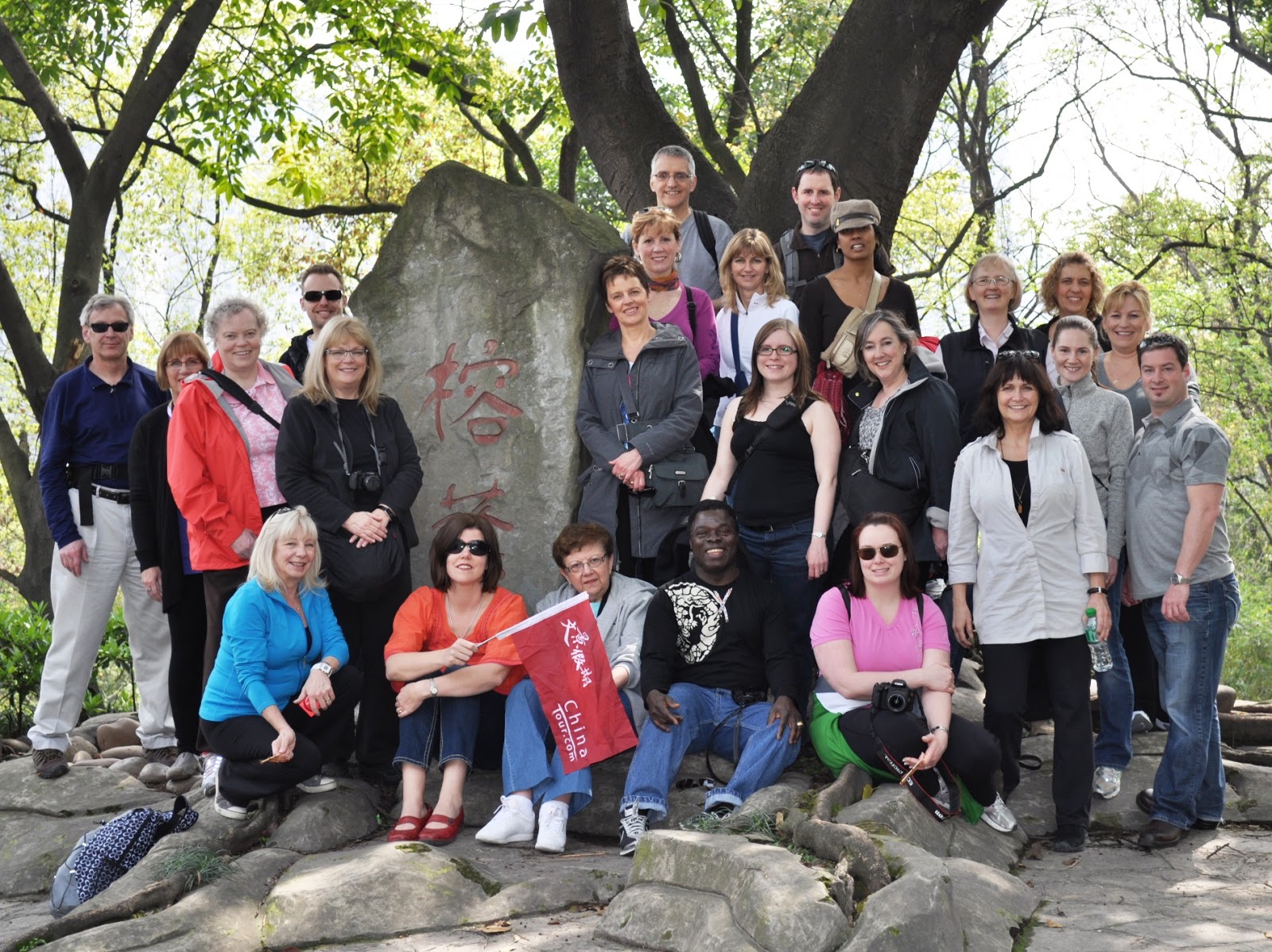
A group photo with all of us from Canada and some of the staff and student guides from Yu Bei Middle School
A sign welcoming us to their school
This sign switched back and fourth between English and Mandarin
There was an official welcome ceremony for us when we arrived, complete with gifts from the school
My name in Mandarin characters
This is a typical classroom.  The students never switch classrooms, the teachers do.  They are officially in school for about eight or nine hours per day and then have another three or four hours of study hall each evening!
This is a small section of the campus.  The whole place was huge and resembled a university campus.
Outdoor basketball courts and that is the school's indoor stadium in the background
This is your typical dorm room for the students.  Six students will live and study in this small space.
Each dorm had one shower and toilet combination and it wasn't even located inside the room.  Each bathroom was outside on the balcony with a door to protect you from the elements.
This was our student tour guide for the morning
Lunch was a traditional Hot Pot meal.  Each place setting had a hot plate with a large bowl divided into two flavours.  One side was very spicy, while the other was more of a chicken (read pigeon) broth.  You put different types of meat and vegetables into the pot and let it cook and soak up the flavour, then you pulled it out with chop sticks and ate it!
There were many different items to choose from.  This particular dish was Ox stomach!
After lunch we broke up into smaller groups and each spent the afternoon visiting a different school
Another sign welcoming us to their school
A much smaller group photo in the school's garden
The garden area was a new addition to the school campus and they were eager to show it off.  It was beautiful to walk through.
Inside one of the building's courtyards.  Those are all different classrooms behind me!
We referred to the English translation of many signs as "Chinglish"!
This classroom gave us a standing ovation when we entered.  We watched the teacher give part of her lesson to the students then it was our turn to get involved.  
A group of students had to teach each one of us a Chinese poem in Mandarin that we then had to recite in front of the class.  This is me screwing up the entire thing and getting laughed at by all of the students!!
The Chongqing Zoo
Famous for its Giant Pandas
Red Pandas
Another humorous sign
Giant Panda
They weren't very active.  They mostly just sat there eating Bamboo.
Chongqing isn't a popular destination for Western tourists.  We were told that some of the locals had likely never seen a Caucasian in person before.  It wasn't uncommon for some of the locals to come up and ask to have their picture taken with us.  This was the first time it happened to me and it was a little embarrassing.  I guess I now know, at least on some level, what a celebrity must feel like!  
Bactrian Camel
White Rhinos
Asian Elephant
Giraffe
South Asian Tiger
Everything was starting to bloom
This little boy ran out just as I was taking the picture.  I think it turned out better with him in it.
Our tour group at the zoo
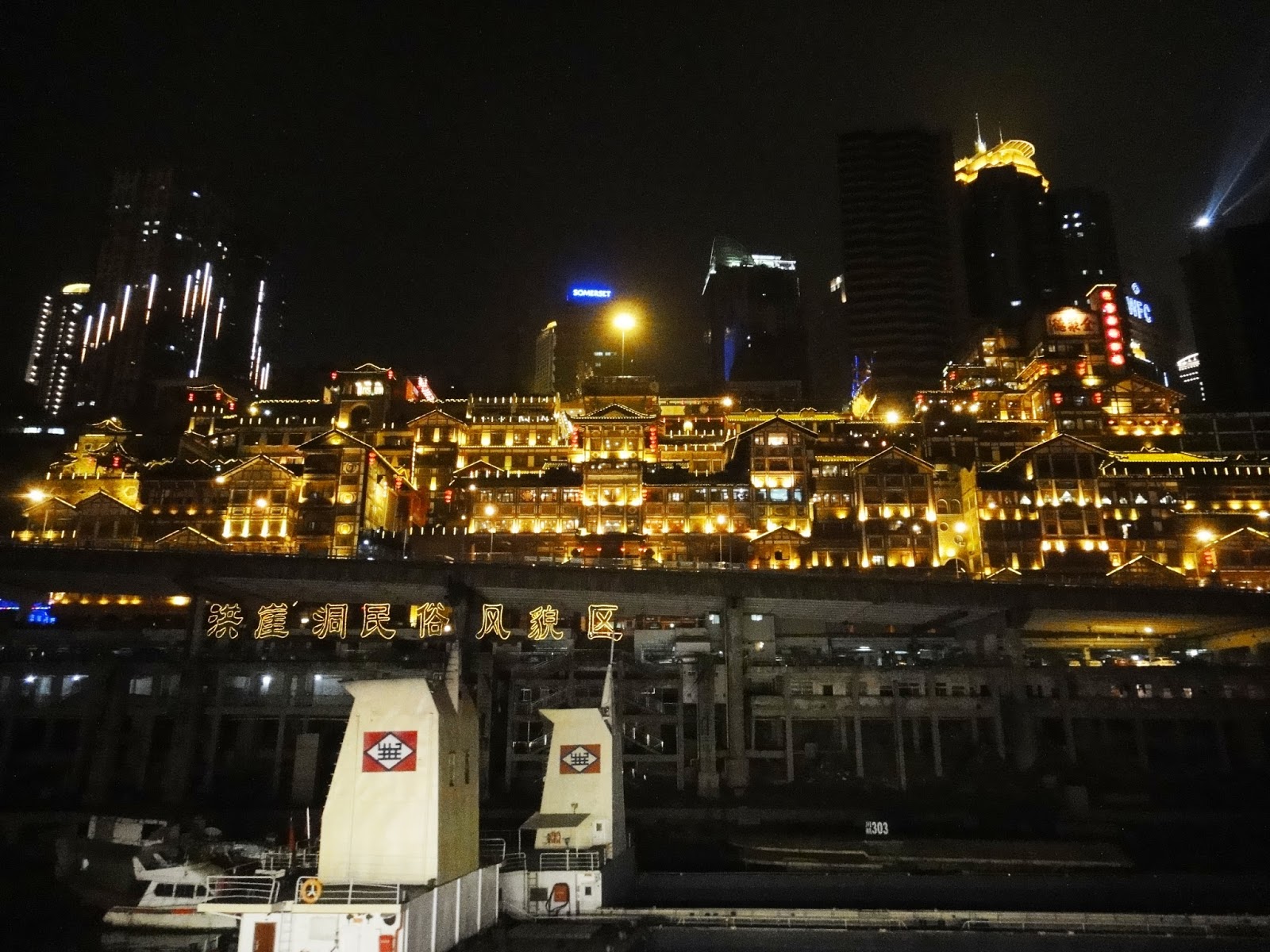
Hongya Cave.  When Chongqing was established in the early Ming Dynasty, there were 17 gates to the city.  The Hongya Gate was among the eight gates that were kept closed and only used for military purposes.  Today it is a popular spot to learn about Chinese culture and it also has a vibrant nightlife.  
Lanterns at Hongya Cave
Hongya Cave overlooks the Jialing River.  They're building a new bridge (at left) and the green building in the background is Chongqing's Grand Theatre.
A replica of the cannon that was installed here during the late Ming Dynasty
Anyone interested in duck for lunch?  Tasty, but extremely spicy!
The Great Hall of the People
Standing in the People's Square
The Pailou Archway stands in the centre of the People's Square
He was selling items out of his baskets in the square
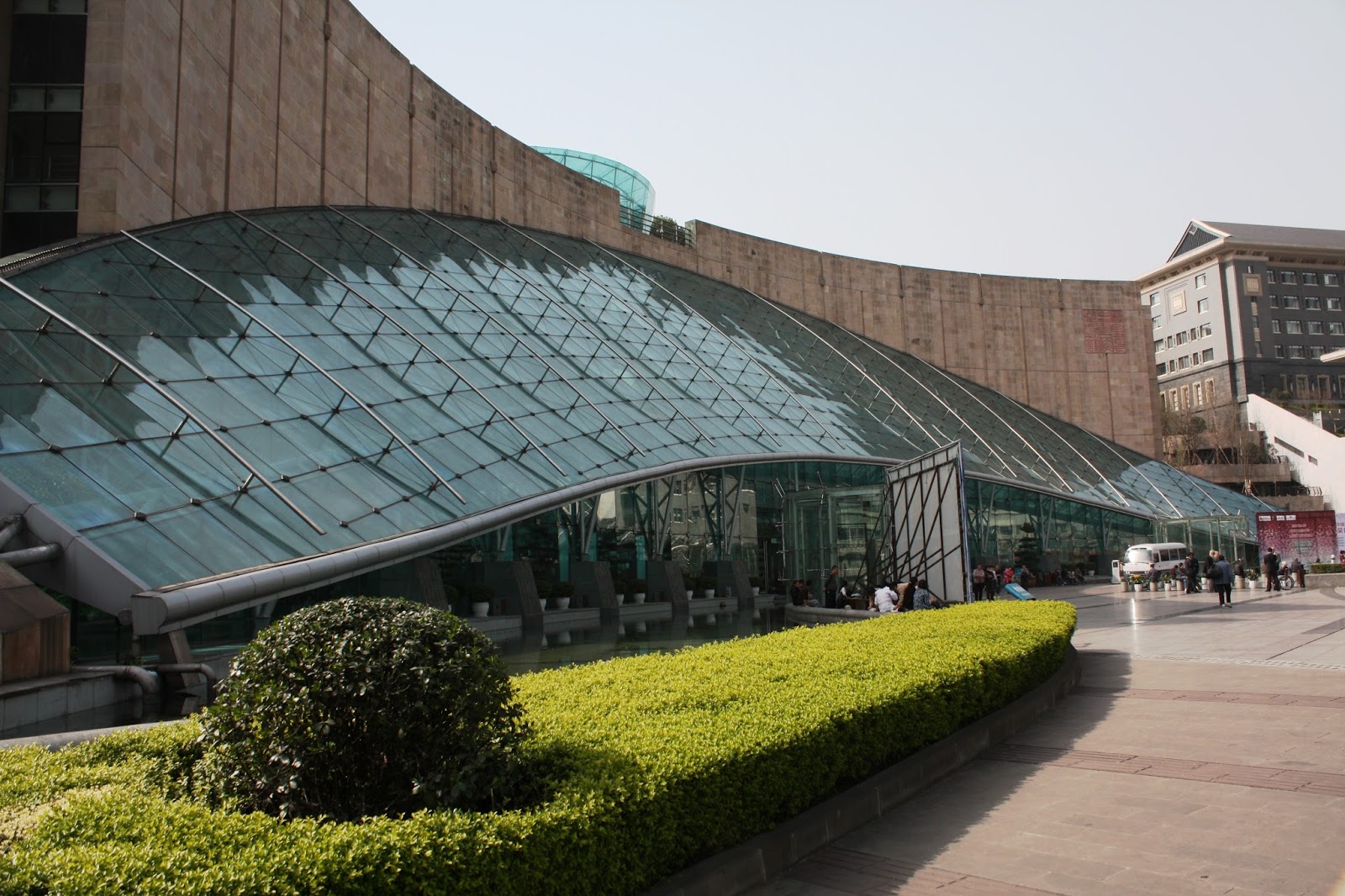
The Three Gorges Museum is at the opposite end of the square from the Great Hall of the People
We did a night time river tour of Chongqing on this boat
This is the six-star Sheraton Hotel that was still under construction
Hongya Cave at night
The next day we visited Ciqikou, which is a 1,000 year-old town that is now part of Chongqing proper.  This gate was the entrance to the old town.
These decorative balls lined the street
This is Zhong's Yard.  Zhong was a royal servant during the Qing Dynasty.  It is estimated this residence is about 120 years old.
We stumbled upon this altar after venturing off the busy main street.  We aren't sure what its purpose was though.
Anyone up for squid tentacles on a stick?
Spices and hot peppers being sold in the market
2012 was the Year of the Dragon, so we saw a few of these decorations throughout the tour
Ciqikou is also home to a 1,500 year-old Buddhist Temple.  This is the entrance to the temple.
There were intricate carvings throughout the temple
We climbed the Pagoda to ring the bell.  This is the view of Chongqing from the top, complete with smog!
Ringing the bell in the Buddhist Temple

Overlooking the main courtyard in the temple from the top of the Pagoda
A Buddhist statue
When we entered the temple we were given a package of incense.  When we arrived in the courtyard we had to light them and place them in this altar.  
The Monks were selling these ribbons in the courtyard.  You could purchase a ribbon, write your prayers on it, and then hang it in the trees.  The idea behind it was when the ribbons blew in the wind, your prayers would be taken to the heavens and answered.
A gold Buddha statue in the temple
The temple's courtyard with the Pagoda at left
A couple of the Monks
Overlook Tower in Eling Park
Another elevated view of the concrete jungle that is Chongqing
While in Eling Park we also visited a tea house where we sampled different teas and learned the proper way to drink them
The People's Liberation Monument in downtown Chongqing.  This was erected to honor victory in World War II.
The last place we visited was the Chongqing Cultural Centre
This is a 700 year-old archway
Some of the locals come to the centre to practice Tai Chi in the gardens
Koi Fish in a pond
This was a park right next to the cultural centre
A perfect reflection in the lake
Another Pagoda in this park
"Carefully Slipping" through the Beijing Airport, which is the largest man-made structure in the world in terms of area!
Our hotel in Beijing was the Great Wall Sheraton Hotel
Beijing's Capital Normal University.  We were given a presentation by one of the resident professors.  
We were also given a lesson on Chinese paper cutting, which was a lot harder than it looked!
I guess there was fish on the menu for lunch that day
That afternoon we visited the Summer Palace.  This is one of the original gates to the palace.
Most of the palace sits atop Longevity Hill, which overlooks Kunming Lake
Construction started in 1750 as a luxurious garden for royal families to rest and entertain, but eventually became the main residence of royal family members near the end of the Qing Dynasty.  
This is the Long Corridor.  It is 728m long and contains 14,000+ individual paintings!
The Temple of Buddhist Virtue
The Paiyun, or Cloud-Dispelling, Gate
The Marble Boat, originally built in 1755, is actually made out of wood, but painted to resemble stone
The Bronze Pavilion
The Prayer Wheels Pavilion
Panoramic view of Kunming Lake
The Sea of Wisdom Temple
Looking back towards Beijing
1,100+ individually hand-carved Buddhas are featured on the exterior walls of the Sea of Wisdom Temple
Beijing's National Stadium, also known as the Bird's Nest, was the site of the 2008 Summer Olympic Games
The National Aquatics Centre, better known as the Water Cube
Pangu Plaza, or the Dragon Building
The next morning we were off to the Great Wall of China
Group photo before we set off to explore the wall
We stopped at the Badaling section of the Great Wall
This section of the wall was originally built in 1505 during the Ming Dynasty
Standing at the highest point of this section, known as Beibalou, which is 1,015m above sea level
Looking down from the top.  It was just a sea of people!
Inside one of the many watch towers.  Standing on the Great Wall was one of my favourite moments from this whole trip!
Standing at the opposite end of the Badaling section.  You can see the highest point in the background.
When the wall was being built they didn't have cement or mortar, so they used sticky rice and lime dust to hold everything together!
The original wall was 8,000+km in length, but today only about 5,000km remain.  Despite what you may have read or heard, the Great Wall is not visible from space or the moon, that is just a myth!
The Temple of Heaven is a series of religious buildings that was visited by Emperors of the Ming and Qing Dynasties to pray for good harvests.  This building is literally called the Hall of Prayer for Good Harvests.
One of the Three Main Halls that surround the Hall of Prayer for Good Harvests
These ladies were dressed in traditional clothing
This is the Imperial Vault of Heaven, which is completely surrounded by the Echo Wall
The last structure that comprises the Temple of Heaven is the Circular Mound Altar
Looking back at the Temple of Heaven buildings.  The temple was constructed between 1406 and 1420.  
Outside the Circular Mound Altar were a series of Burning Stoves used for non-human sacrifices
798 Art District in Beijing
Is this in honour of Jurassic Park?
Marxist Dragons
Becky and I in the "You & Me" Art project
The Zhengyangmen Gate Tower sits at the southern end of Tian'anmen Square and was once the southern gate in Beijing's historic city wall.
The National Museum of China marks the eastern side of Tian'anmen Square
The Great Hall of the People is the western boundary of the square
The Monument to the People's Heroes is at the centre of Tian'anmen Square
The Mao Zedong Memorial Hall sits just south of the central monument.  This hall houses the remains of Chairman Mao, who was the founding father of the People's Republic of China from its establishment in 1949.
While standing in Tian'anmen Square these girls came running and screaming over to us.  All they wanted was a picture with a couple of white boys!
Tian'anmen Gate Tower, complete with a portrait of Chairman Mao, sits at the north end of Tian'anmen Square and acts as the starting point to get into the Forbidden City
Waiting outside the Meridian Gate.  It took quite awhile to actually get inside the Forbidden City.
The Gate of Supreme Harmony
This moat flows between the Gate of Supreme Harmony and the Hall of Supreme Harmony
The Hall of Supreme Harmony.  The Forbidden City was the Chinese Imperial Palace from the Ming Dynasty until the end of the Qing Dynasty, a period of almost 500 years.  Built between 1406 and 1420 it houses 980 buildings and covers 720,000 square-metres!
The more figures on the roof, the more important the building was.  This was a very important building!
This is a cauldron used to store rain water in case of a fire.  Invading forces assumed the cauldrons were made of gold, so they scratched them to find out.  They are not made of gold, they only look that way.
This is Kobe, our tour guide in Beijing
Part of the Hall of Mental Cultivation was purposely left unrestored so you can see the difference
The Pavilion of 10,000 Springs sits in the Imperial Garden
Standing outside the Gate of Divine Prowess
Chang'an Avenue was the site of the famous "Tank Man" photograph from 1989
This unknown protester stood in front of a column of tanks the morning after the Chinese military had suppressed the Tain'anmen Square protests by force.  Little is known about the man or his fate after the confrontation that day.
We did a Rickshaw tour of a Hutong.  Hutong's are traditional old-style neighbourhoods in China.
Colleen and I in our Rickshaw
The Bell Tower
The Drum Tower.  Together these two towers were the official timepieces of Beijing until 1924 when the last Emperor of the Qing Dynasty was forced to leave the Forbidden City and western-style clockwork was made the official means of keeping time.
One of the original Watchman's Drums
Replica Watchman's Drums
Here's a sample of the drumming performance we saw in the Drum Tower

Jason and I decided to attend a soccer game with Kobe and his friends.  The game was between Tianjin Teda FC and Beijing Guoan FC and was being held at Worker's Stadium.
A show of force outside the stadium
Inside the stadium
The Beijing fans.  Not quite as crazy as the fans in Rio de Janeiro, but still very passionate about soccer!
Here's a video clip of Beijing scoring a goal and the crowd's reaction.  The final score was 3-1 in favour of Beijing so everyone left in a very happy mood!

This was a pretty amazing trip and a great way to experience another country and culture.  As you can see we ate traditional Chinese meals all the time and were able to experience different things, like visiting schools, that wouldn't otherwise be allowed had we been travelling on our own.  I have heard that the CBE does a similar trip to India.  I guess I'm going to have to keep my eyes and ears open and try and get on that trip in the future!