Saturday, August 9, 2014

Tanzania

Trip Dates: July 18th - 26th, 2014


We were picked-up at the airport by our new driver/guide, Charles, from Bush 2 Beach Safaris.  We were all pretty tired from the red-eye flight from Uganda, but it was hard not to be excited at the same time.  Charles drove us to the Ilboru Safari Lodge in Arusha where we'd be spending the night before embarking on our first real safari the next morning.  


Tanzania, officially known as the United Republic of Tanzania, is a coastal country in Eastern Africa.  They have a population of 44.9 million people.  The capital city is Dodoma, but the largest city, in terms of population, is Dar es Salaam with 4.3 million people.  The official languages are Swahili and English.  For the most part, our time was spent in the north-central part of the country where we visited Tarangire National Park, Ngorongoro Conservation Area, and Serengeti National Park.  

Tanzania (dark blue) as located within Africa (light blue)
A map of the different regions and parks in Tanzania
As previously mentioned Bush 2 Beach Safaris was our main contact while booking this trip and they were phenomenal throughout the entire process.  I would highly recommend them to anyone looking to travel in East Africa.  Ingrid, one of the owners, met us at the Ilboru Safari Lodge just to check-in with us and make sure everything went smoothly in Uganda.  She also gave us a briefing on the next couple of weeks and what we could expect.  Everything was very professional and courteous.  It was the little things, like meeting Ingrid, that were unexpected and unnecessary, but very much appreciated and indicated they were willing to go above and beyond.

Our drive/guide Charles, was a very quiet, soft-spoken individual, but extremely knowledgeable.  There wasn't a single question he couldn't answer for us and once he warmed up to us, was more willing to show his sense of humor.  Unlike in Uganda, Charles shared many meals with us and this gave us a chance to really get to know him and find out more about his background.  Although I don't have a lot to compare them to, Charles and the entire Bush 2 Beach team, were all terrific and get my full endorsement!


Charles picked us up the next morning and we were off to Tarangire National Park.  Tarangire is the sixth largest national park in Tanzania and is famous for large herds of Elephants and Baobob Trees.  Aside from the Elephants, Tarangire is also home to numerous other animal species including, Waterbuck, Impala, Warthog, Giraffe, Wildebeest, Jackal, Lion, Cheetah, Zebra, Cape Buffalo, Ostrich, Reedbuck, Eland, Dikdik, Baboon, and Vervet Monkey, all of which we were fortunate to see.

Tarangire National Park
Baobob Tree
Waterbuck
Wildebeest dashing across the road
These Elephants are eating the innards of a Baobob Tree
The Tarangire River flows through the park and is the main source of water during the dry season
Our lunch spot came with an amazing view of the park
Vervet Monkeys were stealing food directly off plates in front of people.  It was pretty entertaining to watch, as long as it wasn't happening to you!
It didn't take long for the Baboons to show up either
Reedbucks along the river
This baby Elephant was trying to cool off in the water, but had lots of trouble getting back to his feet
We found another group of Elephants using a mud hole to cool off.  The mud acts as a shield from the sun and also prevents the flies from biting them.
Male Ostrich
A couple of birds hitching a ride on the back of a Giraffe
We stayed at the Tarangire Safari Lodge for one night.  That evening, as Mike and I were walking from our tent to the lodge, we noticed a small herd of Elephants walking among the tents.  We quickly grabbed our cameras and started snapping photos of the enormous creatures.  I ran and got the girls, as I knew they wouldn't want to miss this opportunity.  The staff of the lodge had named them as they were frequent guests to the area.  The mother was Doris and she had three of her calves with her.  The two older ones were Happy and Ronaldo, who received his name because he liked to kick things!  The youngest calf was still unnamed at the time.  It was an amazing experience to watch them up-close outside of a vehicle.

The view from the lodge was unbeatable
Doris
Doris would head-butt the trees so the thorns would fall off and then they'd all pick them up with their trunks and eat them.  You can also see how close they were to our tents!
We were up before the sun the next morning for a dawn game drive and then returned to the lodge for breakfast.  We had a short game drive on the way out of the park before making our way to the Ngorongoro Conservation Area.

These young Baboons were sitting in a large pile of Elephant dung.  They would sort through it and decide on the best parts to eat.  They couldn't have been happier about it!
A Lion paw print in the sand
Dik Diks are the smallest members of the Antelope family
When startled, Warthogs will run through the tall grass with their tails straight up in the air.  This is so the other members of the family can see the leader and follow along.
As we were leaving Tarangire we spotted these three Cheetahs sitting under a tree in the shade.  A nice parting gift as we moved to the next park.
We left Tarangire behind and made our way to the Ngorongoro Conservation Area, which is home to the famous Ngorongoro Crater.  The Ngorongoro is classified as a conservation area instead of a national park because the Maasai people are allowed to live within it's borders, although they have been evicted from the crater itself.  The Maasai are not hunters or farmers, so they don't pose a risk to the resident wildlife, nor do they disturb the land, and have therefore been granted access to live within their traditional territory.  

We would be spending two nights at the Rhino Lodge near the crater's rim.  Shortly after our arrival we were taken on a nature walk by one of the Ngorongoro Rangers.  We learned about the area and how it was formed, as well as some of the traditional uses for many of the native plants.  The Ngorongoro Crater is home to the densest population of predators in all of Africa.  For this reason female Elephants and their young don't venture into the crater, only the largest bull Elephants will do so.  25,000 large mammals call the crater home, including approximately 20 Black Rhinos, which account for about half the remaining population in all of East Africa.  

A panoramic shot of the Ngorongoro Crater
We work up to a herd of Cape Buffalo just outside our hotel door.  The rim of the crater is quite high and this morning we were fully enveloped by clouds.
After a good night's rest we hopped back in the Land Cruiser for a full day safari on the crater floor.  The safari gods were looking after us again as we saw all of the following species, Thomson's & Grant's Gazelle, Warthogs, Wildebeest, Cape Buffalo, Lion, Hyena, Jackal, Hippopotamus, Elephant, Rhinoceros, Zebra, Ostrich, Baboon, Vervet Monkey, Hartebeest, Black-Tailed Mongoose, and Serval, which are apparently extremely rare to see.  

Cape Buffalo
This male Lion was dozing beside his brother
This next series of photos captures one of the best moments of the entire trip.  We noticed a large gathering of parked vehicles, so Charles drove over to see what everyone was looking at.  Shortly after we arrived we saw a female Lion sitting in the tall grass and then we spotted her cubs.  We thought that was pretty cool in itself, but then the mother began walking through the grass towards the road.  She popped out of the grass directly in front of our vehicle and her young cubs weren't far behind her.  We had front-row seats as her and her cubs strolled along the dusty road for more than ten minutes.  There was a line of about 20 vehicles behind ours, all trying to get the view and the photos we were getting.  She dropped down to a pool of water for a drink and then came right back up in front of our vehicle again.  At this point Charles thought we should leave the Lions and let someone else have this amazing experience.  We were more than satisfied by what we got, so we gladly left the cluster of vehicles behind and continued exploring the crater.  We knew this was a rare sight as Charles, who has been guiding safaris for eight years, pulled out his cell phone and was taking pictures of the Lioness and her cubs!

Mama Lion
Charles guessed the cubs were between two and three months old
Mama and her cubs walking in front of us
Cute little cubs
Zebra
We stopped for lunch near this small lake.  It was filled with Hippos, which gave us some entertainment while we ate.
Jackal
Thomson's Gazelle
According to African legend the Wildebeest has been put together by God using leftover spare parts from other animals including the stripes of a Zebra, the mane and tail of a Horse, horns of a Cape Buffalo, and the face of a Grasshopper.
We were lucky enough to see two Rhinos, but this was as close as we got to them
After seeing an abundance of wildlife in the Ngorongoro Crater, it was time to move onto Tanzania's flagship park, the Serengeti.  Serengeti National Park is the country's oldest park and continues to be one of the most visited.  It's popularity likely stems from the great migration that sees 1.5 million Wildebeest and some 250,000 Zebra travel through the park searching for fresh grazing grounds.  We weren't in the Serengeti at the right time to witness the vast herds on the move, but that didn't stop us from having an amazing time in the park.  There was a noticeable absence of Wildebeest, but we did see quite a few Zebras.  Other wildlife we saw in the Serengeti were Elephant, Topi, Hartebeest, Lion, Cheetah, Reedbuck, Cape Buffalo, Rock & Bush Hyrax, Dwarf Mongoose, Hippopotamus, Nile Crocodile, Hyena, Giraffe, Serval, and Leopard.  

Entering Serengeti National Park
In the Maasai language, Serengeti means "endless plains"
Hartebeest
There were two male Lions laying in the grass doing nothing but panting.  It was so hot they didn't want to move!
These three Lions were trying to nap in the shade.  Their bellies looked full, so we assumed that's the reason these Zebras were this close to them.
A herd of Elephants heading for the watering hole
Mama Elephant and her calf
Nine more Lions trying to avoid the hot sun
Topi
Close-up of a bull Elephant
One of the two Leopards we saw.  This rounded out the Big Five: Elephant, Cape Buffalo, Lion, Rhino, and Leopard.
While in the Serengeti we stayed at the Kati Kati Tented Camp,  which is a small camp situated in the Seronera area of the park.  There were no fences to keep the wildlife out and it was quite common to see Hyenas walking around the camp after the sun had set.  It was a bit freaky, but pretty neat at the same time.  We also heard rumors of a Honey Badger getting into the kitchen tent, but we still aren't sure if this was just the camp's staff messing with us!    

Serengeti sunset at the Kati Kati Camp
Hyenas have been known to chase a Cheetah off of it's own kill
We didn't see these Hyenas kill the Gazelle, but we watched them eat it.  Then, we watched them play keep-away with the meat from an Eagle and a Vulture!
Sisters on safari!
Giraffe
A couple of Nile Crocodiles sunning themselves
There was a large gathering of Hippos in this pool.  Standing on the bank, we watched them grunt, bite, and chase each other if one happened to get too close to another one's females.  Being the most dangerous animal in Africa, it was a bit intimidating being so close to them.
For some reason these guys turned out to be Christine's favourite animals!
The morning we were leaving the Serengeti this handsome fellow decided to pose perfectly for us!  In the Swahili language the word for Lion is "Simba".
We turned a corner and saw these two Cheetahs drinking from a puddle on the road.  Charles was amazed at how many Cheetahs we saw throughout the trip (12!), because normally Cheetahs can be one of the toughest animals to see.
Our next night was spent at Isoitok Camp, which was close to the Esilalei Maasai Community.  We had a tour booked with the local Maasai people and it turned out we were the only visitors in the camp that night.  Here is some information about the Maasai as provided by the camp:
Esilalei village has been a settlement since 1977, before which the Maasai, its current occupants, lived a nomadic life.  They still enjoy free access across the land, including across the country borders.  Nowadays, Esilalei village comprises over 500 people living in around 50 separate bomas (traditional Maasai settlements), covering the area between Lake Manyara and the mountain ranges running from the Northwest to the East.   
Each boma is of a particular shape, protected from wildlife by a fence made from spiky Acacia branches.  Additionally, in the middle of the boma you will find another enclosed area used to protect cows at night.  Goats are also kept in the boma when not out grazing. 
There are an average of five to six houses in each boma, depending on the number of wives the elder has.  The houses include a small cooking area and stove as well as sleeping areas.  A separate warrior house is available in each boma to house any travelling warriors as they pass through. 
The village has one chairman called the "mwenyekiti", but due to the size of the Esilalei community the village has been split into four parts, each with its own mwenyekiti.  These mwenyekiti's look after and resolve any conflicts in the area; any issues that cannot be resolved locally are then referred to the main chairman for resolution.

From around the age of 15, all males train to become warriors, which involves learning to fight and tending the cattle.  Once circumcised around the age of 18 they will become warriors and spend the up to six months in the bush, utilizing their skills and living without water, either to wash or to drink.  Their only means of survival will be a cow, which they can use for blood and milk.  The final step in becoming a warrior is to kill a lion to prove mental and physical strength.  This tradition, however, in locations around national parks and wildlife management areas is strongly discouraged, although it continues in wilderness locations away from park authorities.  Once this is completed, the warrior supports and safeguards the community, tending to livestock, finding adequate grazing and water for 10 - 12 years.  During this time he cannot marry until the individual's father selects a first wife for his son.  Once married he can then choose other wives to his liking and in accordance to his status and wealth. 
Girls are often betrothed at a young age, usually marrying between the ages of 12 and 15.  Once married, the women play a critical role in running the boma.  Their duties include building the mud houses, maintenance, cooking, looking after the children, herding the goats, and milking the animals!  The women also make Maasai jewellery to sell in the market. 
When a warrior completes his years of service and becomes an elder by marrying, he will build his own boma for his wives and possibly his elder mother to live in.  He will be in charge of the day to day running of his own boma.  Elders are highly respected by the rest of the Maasai community.   
The Maasai of Esilalei are mainly Christians, but some retain their traditional beliefs, based on nature.  The Oriteti Trees are believed to hold a god to which the Maasai will pray.  The volcanic area of the Oldonyo Mountains is also believed to be sacred, with the active volcano, Oldonyo Lengai, being the home of the Mountain God.  Christian Maasai attend regular church services; there is one church in Esilalei village that holds a Sunday service that anyone can attend.
The village has a witch-doctor for traditional healing.  Witch-doctors come from a particular clan of people called the Engidong.  Payment for their services is by exchange of cows, thus allowing the witch-doctor to marry many wives and live in larger bomas.   
Both the warriors and women participate in traditional dancing.  For this the warriors gather in a circle to chant and jump while the women shake their bodies and sing.  Usually the warriors take turns to enter the circle and jump as high  as possible.  This dance is also used by the warriors to impress and show off to the young girls and is performed at celebrations and is also a common pastime. 
The Maasai diet is based around cows and goats with cow-milk being the staple ingredient.  In the morning, Maasai drink cow-milk.  Goat's milk can also be drunk, but needs to be boiled before consumption, hence the preference for cows.  During the day they will eat porridge made of corn flour and sheep's fat with milk.  In the evening Ugali is eaten, which consists of maize flour.  Goat meat is usually eaten once a week, with ALL parts of the goat being consumed.  The bones are boiled to make a soup, to which medicine is added to aid in digestion, prevent malaria, and maintain general well-being.  The Maasai drink the goat's blood, as they believe this will clean their own blood and keep them healthy.  Cows are only eaten for special occasions and celebrations; both meat and blood are consumed. 
The Maasai predominantly coexist peacefully with the wildlife.  Snakes, however, are feared and unfortunately , through lack of knowledge and wrong identification, are often killed whether venomous or not.  Predators such as lions, hyena, and jackal can be a threat to livestock and in the past were killed, however these predators keep a good distance from the Maasai settlements with cattle dogs also playing a valuable part in keeping any unwanted visitors away.  
Isoitok means "many stones" in the Maasai language.  It was easy to see how the camp got it's name because the ground was extremely rocky and dry in the area.
Setting sun
Inside one of the bomas
Giving the cows an injection of medicine
The elder of this boma
In this photo you can see the outer fence (right) that protects the boma and the inner fence (left) to protect the cattle
One of the wives carrying her child
A Maasai wife holding her one-year-old daughter
It was pretty incredible to spend some time with the Maasai people.  They are desperately trying to hold onto their culture in a rapidly changing world.  Although they still live, eat, talk, and dress in a traditional manner, it was easy to see the outside world slowly creeping in.  We witnessed the elder of the boma talking on his cell phone, for example, and some of the children were wearing western-style baseball hats and toques with their shuka.  Many of the Maasai children do not go to school, because the adults don't place a high importance on education.  It's much more respectable to stay at home and look after the cattle, in the case of young men, then it is to go to school, but even this right of passage is slowly starting to change.  We saw several Maasai people driving vehicles, speaking English, and even working in town (or as a dive master in Zanzibar), instead of staying home and embracing their traditional lifestyle.

We spent one more night in Arusha, back at the Ilboru Safari Lodge, before catching a short flight to the island of Zanzibar.  Ingrid met us at the airport to see us off on the last leg of our journey.  We said our good-byes to Charles and made our way to the nuthouse that is the tiny Arusha airport.  We had just over a week of vacation left and most of it would be spent on a white sandy beach!

Friday, August 8, 2014

Uganda

Trip Dates: July 11th - 18th, 2014


From Amsterdam we took a 9.5 hour flight to Kigali, Rwanda.  We had a very short, 45-minute layover on the tarmac, before a quick half-hour flight to Entebbe, Uganda.  Our guide collected us from the airport and dropped us off at the Gately Inn, where we'd be spending the night.  In the morning our African adventure would officially begin!


Uganda, officially known as the Republic of Uganda, is a landlocked country in East Africa.  They have a population of approximately 35.8 million people.  The capital, and largest city, is Kampala and the official languages are English and Swahili.  We spent the majority of our time in rural areas in the southern part of the country, visiting Bwindi, Queen Elizabeth, and Kibale National Parks.  

Uganda (dark blue) as located within Africa (light blue)
A map of the different regions of Uganda
We booked our entire trip with Bush 2 Beach Safaris, but each tour company is only licensed to operate in one country.  This meant we would be using their sister company, Great Lakes Safaris, for the Uganda portion of the trip.  Our driver/guide was David and he turned out to be really great.  He was very knowledgeable about the country, the people, and the wildlife.  We learned a lot from David over the course of our week together.


Our first full day in the country featured a long drive from Entebbe, up to Kampala, and then southwest through Masaka, Mbarara, and Kabale to Lake Bunyonyi.  We passed through countless small towns and villages and were treated to a few hours of "African Massage", which is the polite way of saying, extremely bumpy roads!  We spent the night at the Birdsnest Lodge on the shore of Lake Bunyonyi, which is rumored to be between 44m (144ft) and 900m (2,952ft) deep.  If true, that would make it the second deepest lake in Africa.  

We spent a lot of time inside this Land Cruiser
We stopped at the Equator on our drive to Lake Bunyonyi
It was the first time any of us had stood on the Equator
Beautiful Lake Buyonyi as viewed from our balcony
Grey-Crowned Cranes are the official bird of Uganda
The next morning we toured the lake via canoe.  Our end-goal was Punishment Island, which is a tiny island with a single tree.  The Bakiga people used to banish unmarried pregnant women to the island so they would die of starvation.  This was done to "educate" the rest of the women not to make the same "mistakes".  If a man did not own any cattle with which to pay the bridewealth, he was allowed to go to the island and rescue one of the women, who in turn, would become his wife.  Fortunately this practice was abandoned sometime in the first half of the 20th century, but it is still possible, even today, to find women who have been rescued from Punishment Island.

Canoe selfie on the lake
Punishment Island
After the canoe trip we were back on the road and heading towards Bwindi Impenetrable National Park; home of the Mountain Gorillas.  Bwindi is also home to 350 species of birds, 310 species of butterflies, 200 species of trees, 41 species of reptiles, 88 species of moths, and 120 different species of mammals.  It was a long, dusty drive, filled with numerous Africa Massages.  We would be spending the next two nights at Mahogany Springs Lodge in the Buhoma region, which was just outside the park's boundaries.  

We spotted this Black and White Colobus Monkey shortly after entering the park
Our main reason for coming to Uganda was to track the Mountain Gorillas.  There are only three countries left in the world where you can trek with gorillas; Rwanda, Democratic Republic of the Congo, and Uganda.  Bwindi Impenetrable National Park is home to approximately 340 gorillas, which is roughly half the world's population of endangered Mountain Gorillas.  Of those 340, about 116 are considered to be habituated and they comprise 10 different family units.  

We would be tracking the Kyaguliro Gorilla Family, which is one of three in the Ruhija region of the park.  The Kyaguliro Family was just opened for tourist access in July 2013, making it one of the newest families that you can visit.  This particular family has 19 members, including two silverbacks.  The dominant silverback is Rukina and the second silverback is Rukara.  They also had five or six babies that were constantly running around and wrestling with each other.  All of the habituated gorillas are known individually by the rangers and have been given names in order to identify them.  There are strict regulations around who, how, and when the gorillas can be visited and our time with them was limited to a maximum of one hour.  

We hiked for an hour through dense vegetation and down a steep gorge before we found the family
A female member of the Kyaguliro Gorilla Family
This is one of the playful youngsters
One of the two silverbacks.  This guy was estimated to be 200kg (440lbs).
A close-up of another member of the family
By far, this was one of the coolest things I have ever done!
After our unforgettable experience with Bwindi's gentle giants, we were given an opportunity to visit a Batwa Pygmy Tribe that was living within walking distance of our lodge.  We were intrigued by them and wanted to learn more about their culture, so we gave David the green-light to set it up for us.

Traditionally, the Batwa Pygmies were forest dwellers who lived in caves and hunted and gathered for sustenance.  For thousands of years they were known as the, "Keepers of the Forest" and they lived peacefully within Bwindi's dense jungle.  In 1992 the Impenetrable Forest became a national park to protect the Mountain Gorillas and the Pygmies were evicted from the only home they'd ever known.  They became conservation refugees in an unfamiliar and unforested world.  Unskilled in the ways of farming and relying on broken promises from the government, the survival of the Pygmies was threatened.  Our guide explained to us that conditions were so bad that a small group eventually defected back to the forest and are now living illegally within its borders.  Missionaries and tourism have helped keep their traditions and culture alive as the Pygmies try to integrate themselves into an unknown world.
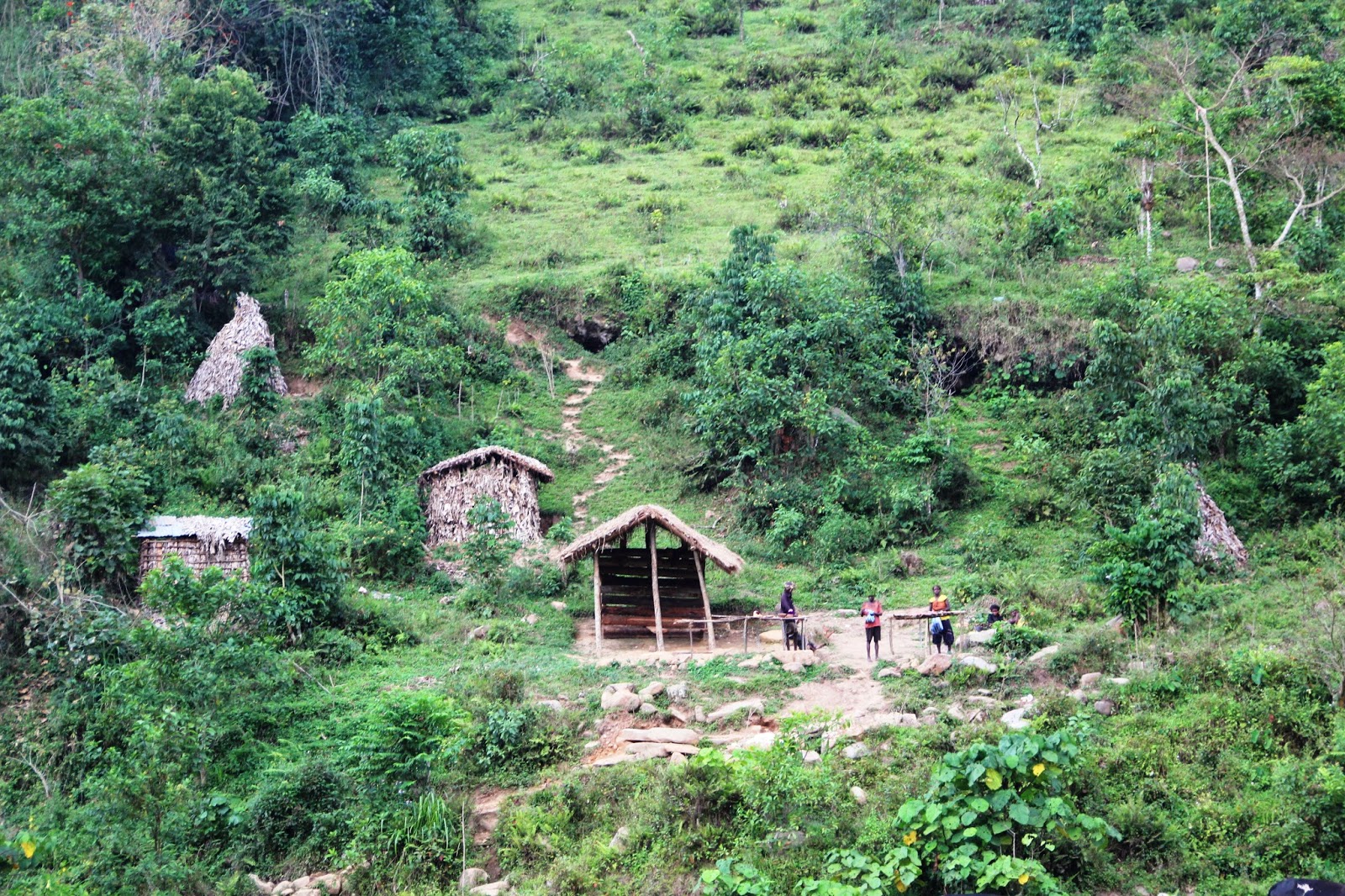
The Batwa Pygmy village near the Mahogany Springs Lodge
Our visit with the Batwa people featured a tour of the small village, a hunting exercise using a bow and arrow, a traditional song and dance performance, a fire lighting demonstration, and finally we were given an opportunity to sample some of their cuisine.  We were all given a chance to hunt using the bow and arrow.  Christine hit the target on her first try, but I was absolutely terrible at it!  Sarah and I were each asked to take part in a dance with a few members of the tribe.  We attempted to mimic their movements, but I feel we thoroughly butchered the performance.  Mike was given an opportunity to light a fire in the traditional way, by rubbing sticks together.  I'm happy to report that he was successful at it, but he wasn't nearly as fast as they were!  I fear we would be terrible hunters and would be eating a lot of cold meals if we suddenly had to move into the forest!

The hunting demonstration
After the fire was lit, they proved it to us by inhaling the smoldering embers
 All of us had the opportunity to sample roasted goat meat, which Mike and I happily tried.  It was actually pretty tasty, but the fermented banana beer and the incredibly strong banana gin left much to be desired!  The girls decided not to sample the food and I'm happy to announce that both of us managed to avoid getting sick from this tasting experience.

Roasting some goat meat over an open fire
Before we knew it, it was time to move again.  Our next destination was Kibale National Park, but we had to drive through Queen Elizabeth National Park in order to get there.  This gave us a bit of an unexpected safari and made the drive a lot more exciting.  The park is named after Queen Elizabeth II and is Uganda's most visited national park.  It's home to the unique tree-climbing lions, which, disappointingly, we were unable to see during our brief visit.  The park is home to a variety of other species, however, and we managed to see Black and White Colobus Monkeys, Vervet Monkeys, Baboons, Elephants, Topis, Waterbucks, Ugandan Kobs, and Cape Buffalo.

Queen Elizabeth National Park
Ugandan Kob
Vervet Monkey
African Elephant
 We were stopped for lunch somewhere outside Queen Elizabeth National Park when David was approached by a nun who was looking for a ride to a church.  As luck would have it we would be driving by that same church before reaching Kibale National Park.  David asked if it would be okay if we gave her a lift and we agreed that it would be more than fine.  When we arrived at the church all of these children came running up to the vehicle.  The only English word they knew was "sweets".  They kept repeating it over and over again with their hands extended towards us.  They'd obviously been given treats from tourists in the past, but unfortunately we didn't have anything to offer them.  It was pretty cute interacting with them even though none of us could speak the other's language.

Children running to the vehicle hoping for sweets
Later that afternoon we arrived at Kibale National Park and were greeted by a family of Baboons.  The Baboons are one of 13 different primate species that call the park home.  We had traveled to Kibale to search for another species of primate though, the Chimpanzee.  We would be spending two nights at the Primate Lodge in the heart of the park before making the long trip back to Entebbe.  

This is an adult male Baboon that we spotted just inside the park
This baby was hitching a ride on the back of its mother
This is a male Agama Lizard.  They were quite common around the Primate Lodge.
As I mentioned earlier, the main reason we were in Kibale was the Chimpanzees.  It is widely accepted that Chimpanzees are the closest living relatives to human beings, sharing about 98% of their DNA composition with us.  We weren't really sure what to expect, but to be honest I was a little skeptical about the whole thing.  The idea of tracking Chimps seemed a bit anti-climactic after our phenomenal experience with the Mountain Gorillas.  I was willing to give it a try, however, since the tour had been booked and our permits were already paid for.

During the briefing my fears were confirmed when we were told that Chimps spend approximately 80% of their lives up in the trees.  This meant our chances of seeing them on the ground were pretty slim.  Like the gorillas though, our chances of actually encountering them was around 95%, which was reassuring.  There are approximately 1,500 Chimpanzees living within Kibale National Park, but only a small percentage are habituated.  The family we were after are known as Kanyanchu and they have 140+ members, including an old alpha male. 

Once we were in the forest it didn't take very long to find the rambunctious Chimpanzees.  As we expected they were all up in the trees and we were only able to see a handful of them as they feasted on vegetation.  I had positioned myself on top of a dead log to get a better angle for photographs when the girls began yelling at me to "turn around!".  I was distracted because there was a solitary Chimp looking directly at me, which made for a great photo, but the girls continued yelling at me and they were getting louder.  As I turned around I was surprised to see this...

The alpha male had already crossed the log as this old fellow and a young Chimp followed behind him
 The alpha male of the entire family, accompanied by a two elder statesman and a toddler, were walking across a different log directly in front of me.  They couldn't have cared less about my presence and they just kept moving towards me.  Eventually their log paralleled mine and the oldest members of the family were just a few feet away.  I was looking at them, trying to get some photos, while they glanced up at me and kept right on moving.  This single experience made the whole Chimp expedition worth it...and we weren't even close to being done yet!
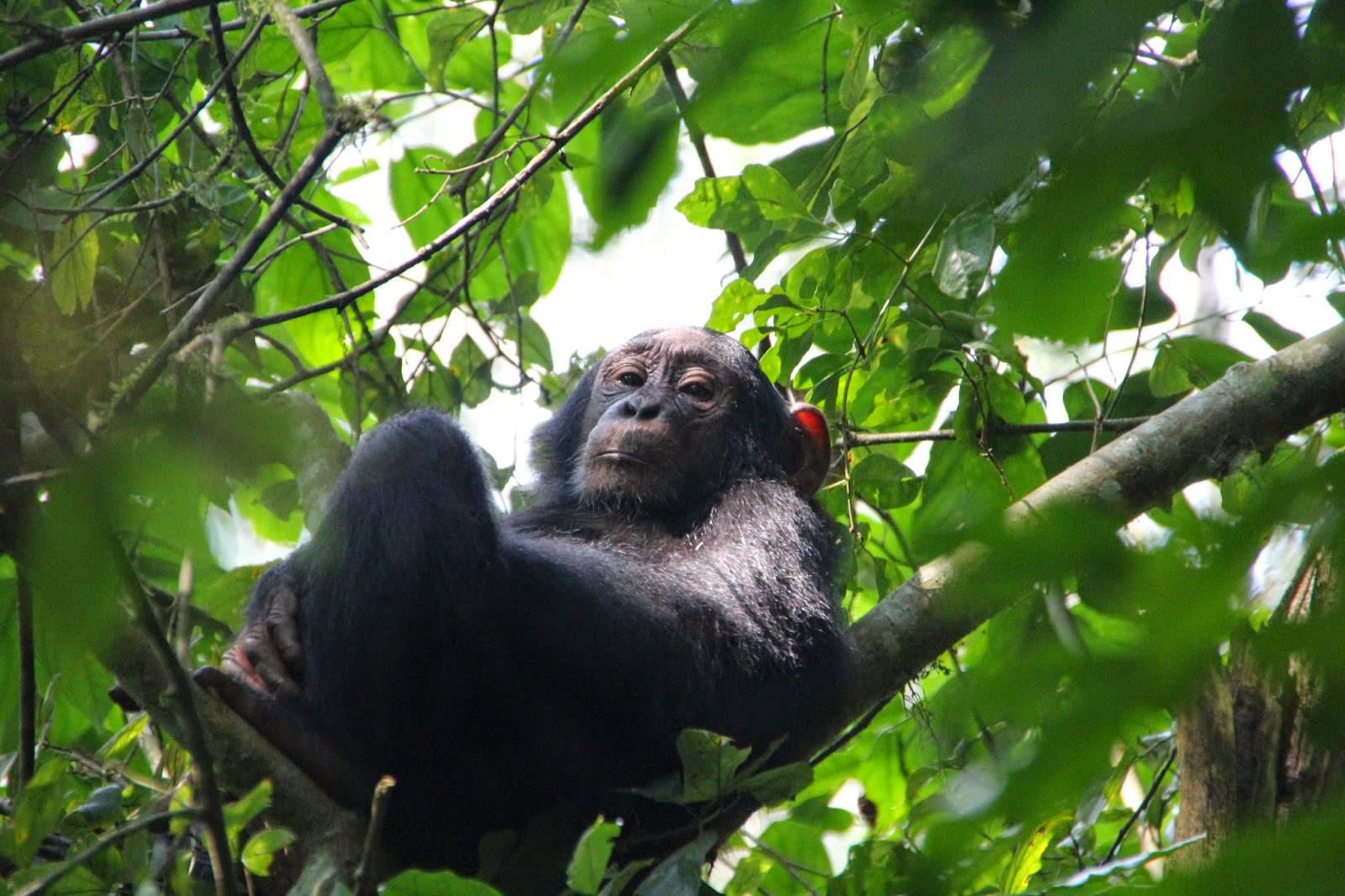
This little guy was just lounging in the trees without a care in the world
He posed like that for quite a while.  We were able to get some neat shots of him.
As the afternoon progressed we kept finding new Chimpanzees on the ground.  Our guide was fantastic.  He ensured we left Kibale with several stories and more than a few memorable photographs of the resident Chimps.  The entire experience turned out better than I ever could have hoped for and was more than worth the additional time and money.

This adult female was very tolerant of humans and didn't mind us being close to her
Our time in Uganda was coming to an end.  David drove us back to Entebbe where we spent one final night back at the Gately Inn before flying into Tanzania.  Unfortunately our original flight had been cancelled, so we'd been moved onto a 3AM flight instead.  None of us slept very well that night, but spirits were high as we landed at Kilimanjaro International Airport and the next leg of our journey began.  

Amsterdam

Trip Dates: July 6th - 11th, 2014


Africa had been at the top of our travel bucket list for quite some time.  With Christine almost being finished school, and before we start having kids, the summer of 2014 was shaping up to be the perfect opportunity for a trip of this magnitude.  We started looking into all the possibilities in the fall of 2013 and wound up booking the trip around Christmas of the same year.  This gave us plenty of time to get the necessary vaccinations, purchase travel visas, and decide how to pack for a month-long expedition.  There ended up being four of us travelling together because Christine's sister, Sarah, and a friend of mine from high school, Mike, both decided they couldn't miss this trip.  

As it's not easy to get to Africa, we thought we'd break up the trip and spend a few days in Amsterdam before taking another long flight.  None of us had been to Amsterdam before, and this would be Mike's first time to Europe, so we were all looking forward to experiencing something new.


The Kingdom of the Netherlands, or more commonly referred to as just the Netherlands, is a small country in western Europe.  It has a population of 16.8 million people.  The official language is Dutch and the country was a founding member of the European Union.  The capital and most populous city is Amsterdam, with a metropolitan population of just over 1.5 million people.  This is where we'd be spending all of our time during our brief stay in the country.

The Netherlands (dark green) as part of the European Union (light green)
Instead of staying in a hotel, the four of us rented a penthouse condo just outside the busy tourist area of Amsterdam.  The location was ideal as we were away from all the crowds and noise that come with bustling urban centres.  We spent the next few days exploring all Amsterdam had to offer.  

We had the top two floors of this building all to ourselves
Amsterdam has been referred to as, "Venice of the North" because it is home to more than 100km of canals.  These canals divide the city into approximately 90 separate islands that are all connected by more than 1,200 bridges.  The three main canals, that are all navigable by boat, are Prinsengracht, Herengracht, and Keizersgracht.  We took a hop-on, hop-off canal tour around the city.  It was a great way to see different parts of the city and allowed us to get off the boat whenever we wanted to explore on our own.  

Prinsengracht Canal
The De Gooyer Windmill was built in 1725 and was moved to its current location in 1814.  It is one of eight windmills that still reside within the city limits.  The De Gooyer Windmill has the honor of being the highest wooden mill in the Netherlands.  It was originally built to mill corn and other grains, but today it is no longer in use and is registered as a national monument.  Unfortunately it is closed to the public.  

De Gooyer Windmill
 Heineken is probably the Netherland's most recognizable export.  The brewery was originally founded in 1864 in Amsterdam by George Heineken and now ranks as the 3rd largest brewer in the world by volume.  They have over 190 breweries in more than 70 countries around the globe.  The original brewery in Amsterdam closed in 1988, but was preserved as a museum called the Heineken Experience.  As avid beer enthusiasts we thought this would be a great way to spend an afternoon.  I'm sorry to report, however, that the Heineken Experience was more cheesy than anything.  There were some really interesting parts of the museum tour, but overall it was more flash than function.  I've been on other brewery tours (ie: Alexander Keiths) and was a little disappointed with what Heineken had to offer.

The Heineken Experience in Amsterdam
 As a complete change of pace from the Heineken Experience, and something that is more than worth the price of admission, we chose to tour the Anne Frank House.  I'm sure most of you know the harrowing story of the young Anne Frank, but in case your mind's a little spotty on the details, I'll give you a bit of a refresher as presented by the museum:
Anne Frank - born in Frankfurt, Germany on June 12, 1929 - was one of millions of victims of the Nazi persecution of the Jews during the Second World War.  In 1933, when Hitler came to power and established an anti-Jewish regime, the Jewish Frank family moved to the Netherlands.  They settled in Amsterdam, where Otto Frank (Anne's father) started a business. 
In May 1940, the German army occupied the Netherlands and anti-Jewish measures were increasingly implemented throughout the country.  On July 6, 1942, Otto and his wife Edith, along with their two daughters, Margot and Anne, went into hiding at 263 Prinsengracht in the building where Otto Frank's business was located.  Hermann van Pels, his wife Auguste, their son Peter and Fritz Pfeffer joined the Frank family in hiding a while later.  The company's building was made up of two parts: a front house and a back house (annex).  The eight people in hiding lived on the upper floors of the annex.  
Anne received a diary as a present from her parents for her thirteenth birthday.  When the Frank family went into hiding, Anne's diary went with her and she kept a detailed account of life inside the annex.  On the morning of August 4, 1944, following a tip from an informant that has still never been identified, the annex was stormed by uniformed German police.  Everybody in the annex was arrested and eventually deported to the Auschwitz concentration camp.  Of the eight people in hiding, only Otto Frank survived the war.  He made the decision to have Anne's diary published.  Today the book has sold more than 30 million copies world wide and has been published in 67 different languages.  
As a sign of respect and to protect the priceless artifacts, photographs were not allowed inside the museum.  In the photo below the two buildings on the right constitute the museum portion of the tour.  The smaller, tan-coloured buildings immediately to the left of the museum are where the families hid.  The secret annex is at the rear of those buildings.  What struck me the most was how small the annex actually was.  It's unbelievable and incredible that eight people lived undetected in that small space for more than two years.

The Anne Frank House
Statue of Anne Frank outside the Westerkerk Church
The Westerkerk Church was completed in 1631
Amsterdam's infamous Red Light District
The Royal Palace in Amsterdam is located in Dam Square.  Construction started in 1648 and wasn't completed until 1665.
The National Monument is located opposite the Royal Palace in Dam Square
It's hard to tell in the photo below, but many of the homes along this canal are lopsided or leaning.  Due to these problems, they're referred to as the "Dancing Houses" and can be found along the Damrak, which is an avenue and partially filled-in canal in the heart of Amsterdam.

Dancing Houses along the Damrak
The Basilica of St. Nicholas is Amsterdam's most prominent Catholic Church.  After only three years of construction, the church was completed in 1887.
 The city of Amsterdam is estimated to have over 880,000 bicycles, while there are only 263,000 vehicles registered.  This isn't hard to believe as there are, literally, bikes everywhere.  It is the most bicycle-friendly city I have ever been to and is widely considered to be the most bicycle-friendly capital city in the world..  In the photograph below you will see a small tower.  This is a bicycle garage.  It is similar to the parking garages for cars that we have in our cities across North America, but this is strictly for bikes.  As you can see from the bicycles parked around the outside, this garage is far from big enough.  In fact, Amsterdam's shortage of bicycle parking spots has resulted in bicycles being taken to the central bike depository after receiving a warning, much like a car being towed for parking illegally.  

Bicycle parking is at a premium in Amsterdam
Spending a few days in Amsterdam was a great way to kick-off our vacation.  It gave us a break between long flights and allowed us to acclimate to the eight-hour time change.  Although it was a quick visit, and we really enjoyed ourselves, we were all pretty excited to get to Uganda and begin our East African adventure!