Sunday, January 24, 2016

New Camera - First Check

Trip Date: January 2016


In late January Rome and I hiked out to my new trail camera to change the batteries and check to see what had been captured.  You'll remember that I set up this new camera in a different location after my previous camera was stolen (read the full story right here).  It was a chilly morning when we started, but we were quite comfortable once we were moving.  The hike to the camera was uneventful and I couldn't help but notice how much snow had melted since I was previously there.  

After approximately one month I had some pretty decent results, but not the wide variety of species I had been hoping for.  Coyotes, Cougars, and Snowshoe Hares were the only wild critters to stroll past my camera.  Unfortunately I had a lot of human traffic, which was quite discouraging considering what happened the last time.  

A large Cougar strolling past the camera
It's difficult to tell if this is the same Cougar as the above photo or a different cat all together
A curious Coyote sniffing around
Snowshoe Hare
Another Coyote making his midnight rounds!
I also noticed that most of the daytime photos were quite dark and underexposed (i.e. the top Cougar photo above).  Between the underexposed photos and the immense human presence I decided to pack up my camera and relocate it.  

I contacted Moultrie's customer service regarding the underexposed photos and they recommended I send my camera to them for analysis and testing, which I did.  I haven't received my camera back just yet, but am hoping to get it shortly.  I've got another location in mind, which will hopefully have a lot less human traffic and a lot more wild animals.

Stay tuned for the next phase in my trail camera project!

Sunday, January 10, 2016

Phoenix

Trip Date: January 2016


In early January, just after New Year's Eve, Christine and I were back on a plane and headed for Phoenix, Arizona.  This was the first time either of us had been to the Phoenix area.  We both had wanted to see an NFL game for a long time, so we bought tickets and booked our flights!  

We arrived in Phoenix on Saturday in the afternoon.  We had pre-booked a rental car, so we picked that up first and then headed for our hotel, the 3 Palms, which was located in Scottsdale.  After we were checked-in and settled we headed to Old Town Scottsdale for a few drinks and a bite to eat.  Old Town is located on the original town-site of Scottsdale and has a distinct old-meets-new western feel.  There are original buildings from the late 1800's that feature modern tenants and the whole area is filled with restaurants, bars, pubs, shops, art galleries, and more.

Old Town Scottsdale
Sitting on the patio of Salty Seniorita
Sitting by the fire at the Brat Haus
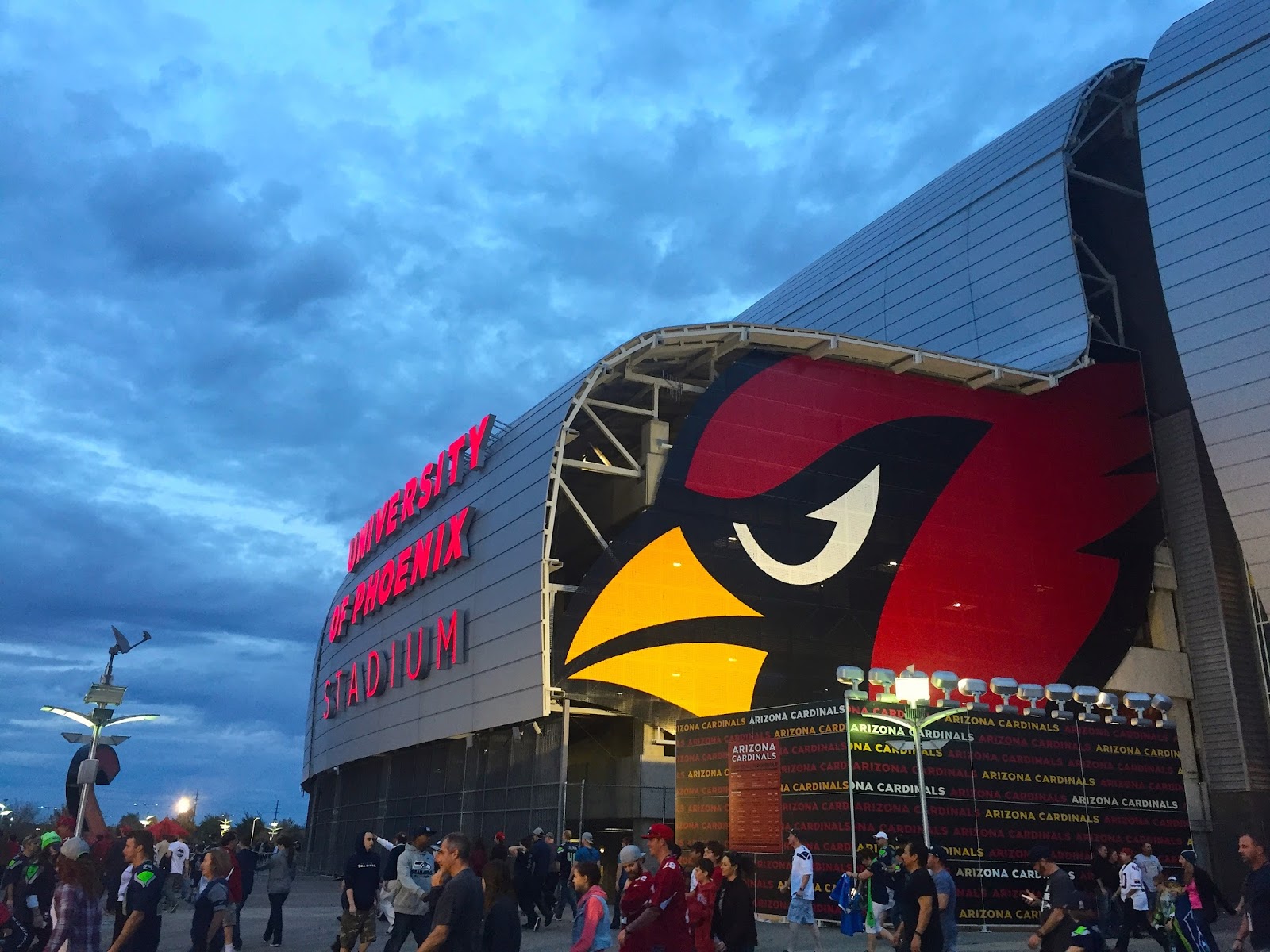
The next day was Sunday, which only meant one thing...football!  We headed back to Old Town for breakfast and to watch the starts of the early games before making our way to Glendale, which is approximately an hour's drive from Scottsdale.  The Arizona Cardinals play their home games out of University of Phoenix Stadium, which has both a retractable roof and field, making it unlike any other stadium in North America.  The stadium seats 63,400 fans and was completed in 2006.  The game was sold out because it was the last regular season game and the Seattle Seahawks were in town.  

We got to the stadium pretty early as we wanted to do some tailgating before heading inside.  We were not disappointed with our first tailgating experience!  Unless you've experienced it firsthand it's really hard to describe the whole thing, but if you haven't yet done it and you're a sports fan I suggest adding it to your bucket list!

University of Phoenix Stadium; home of the Cardinals
Outside the stadium
Tailgating before the game
Pre-game
The game itself was pretty incredible.  They certainly know how to build stadiums in the United States.  We barely had to wait in line for anything, including the bathroom, which was something we definitely weren't used to.  The Seahawks easily handled the Cardinals on the day, winning 36-6, but it didn't matter too much as both teams were already guaranteed a playoff spot.

Inside the stadium
Christine and I wandering through the stadium
The Arizona Cardinals being introduced to start the game

Larry Fitzgerald
Fan reaction after Fitzgerald scores the first toughdown of the game.  Sadly those were the only points the Cardinals scored.
Outside the stadium after the game
Statue of Pat Tillman just outside the stadium.  Tillman was a safety for the Cardinals before quitting football and enlisting in the United States Army after the September 11th terror attacks.  Tillman was killed in Afghanistan by friendly fire in 2004.
The next day the weather was chilly and rainy so we headed down to the Phoenix Premium Outlets to do some shopping.  That evening we were back in Old Town for dinner and we wanted to try a few more of the different pubs.
Just a few of the pubs and bars we visited including Majerle's Sports Grill, Bevvy, Rockbar Inc, and Dierks Bentley's Whiskey Row
Why fly down to the desert if you're not going to experience it, right?  Even with the threat of rain the next morning we drove out to Gold Canyon to go for a hike.  We settled on Hieroglyphic Trail, a relatively easy 4.7km round trip hike that gained approximately 175m in elevation throughout.  The trail is located in Tonto National Forest within the Superstition Mountains, which are full of history. The informative sign at the trailhead reads...
The rocky washes and saguaro-studded hills at the base of the Superstition Mountains have lured adventurers for nine thousand years.  Salado, Hohokamam, and Apache Indians gathered here years before the white man arrived.  Spanish explorers sought gold and souls.  Mexican miners, like the Peralta brothers, were said to have taken tons of precious metal from mines in these mountains.  Trappers and adventurers migrated to the area.  Ranchers drove their cattle up the dusty trails.  Farmers tried to scratch a living from the rocky soil.  Eventually the U.S. cavalry was sent in to patrol the area and protect the expanding population. 
A miner named Jacob Waltz ventured into these hills and brought back gold so pure that when he died in 1981 without revealing its source a legend was born.  For more than a century prospectors have returned to the Superstition looking for the "Dutchman's" lost mine, but to this day no one has found it.  In recent years the pristine desert, abundant wildlife, and star-studded nights have lured adventurers of a new sort -- horsemen, mountain bikers, and hikers anxious to share in the wilderness experience.  Enjoy your journey in the footsteps of the past.
Superstition Wilderness in Tonto National Forest
Superstition Mountains
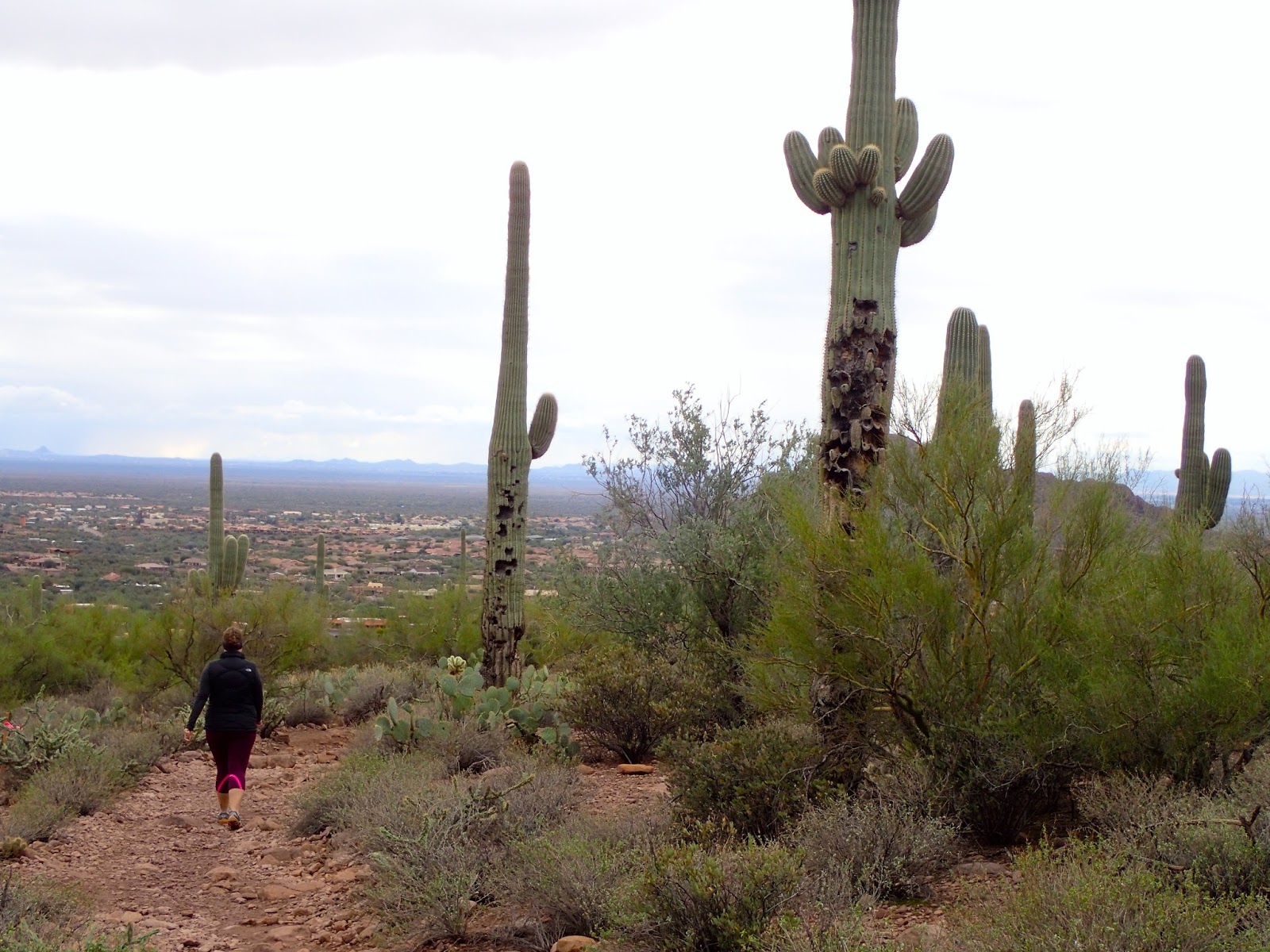
Christine and a Saguaro Cactus
The Saguaro is a species of cactus that can grow to be over 21m (70ft) tall.  They won't start growing arms until they're between 75 and 100 years old!  Some Saguaros will never grow arms and those are then referred to as spears.
Desert Selfie
Besides the beautiful desert scenery, one of the highlights of this trail are the ancient First Nation petroglyphs.  Early European settlers mistook the artwork as Egyptian hieroglyphics and the erroneous name has lived on.  The Hohokam people are responsible for the panels of petroglyphs in the canyon at the end of the trail.  The Hohokam people thrived in central and southern Arizona between 500 and 1,400 AD.  These petroglyphs were likely etched into the rock during that time period.

The canyon section where the petroglyphs are located
Petroglyphs
Depictions of animals
There are several panels of well-preserved petroglyphs in this one location
It was pretty cool to see everything up close and in detail
Standing under a Saguaro
Hiking back to the car
After our hike we headed into Apache Junction for lunch and then planned on driving the Apache Trail; Arizona's oldest highway.  Apache Trail (State Route 88) is approximately 65km (40mi) of narrow, winding, desert road through the Superstition Mountains.  It is an incredibly scenic drive along a paved road, but it is not for the faint of heart...or those who easily get carsick!  There are hair-pin turns and steep cliff drops, with little in the way of safety barriers.  Shortly after Tortilla Flat, the paved road turns to gravel and continues as such until you reach Roosevelt Dam.  The road used to be a stagecoach trail for those travelling through the desert wilderness and is now a popular drive for tourists and locals alike.  We drove to the junction of the pavement and gravel with the intent to continue further, but the gravel section of the road was very rough and rutted, so we decided to turn around and head back.
Canyon Lake Viewpoint in Tonto National Forest along the Apache Trail
Shoreline of Canyon Lake
Desert Scenery
Tortilla Flat
An informative sign along the Tortilla Flat boardwalk read...
Prior to 1906, this location was a welcome stop for travelers on the Yavapai Trail which connected Tonto Basin with the Salt River Valley.  In 1906 the trail, now known as the Apache Trail, was completed as a freight road for the construction of Roosevelt Dam.  Tortilla Flat became an important water and supply stop on the road.  The Apache Trail is now Arizona State Route 88, but Tortilla Flat remains a welcome stop.
The Dutchman's Inn is also located in Tortilla Flat and the sign outside had this to say about the inn's famous proprietor...
Here, Jacob Waltz (The Old Dutchman) Arizona's most celebrated scoundrel, laid the cornerstones for this here eatery.  Waltz was a notorious liar, drunkard, and general miscreant who avoided gainful employment with singular dedication.  It took a lot of looking, walking, and digging to find that rich Peralta Gold Mine among 125,000 acres of Superstition Mountains and even more killing of hombres who attempted to follow him back to his rich mine.  Now all that walking, digging, and killing gave Waltz a real appetite.  Let it be known that ol' Jacob had a reputation for appreciating the culinary niceties of life.  His love of life, a young Phoenix widow who ran a small confection shop and restaurant, testified that the only thing the old Dutchman like more than sin was a good meal!  Unhappy with local dining rooms, be built his own.  Pardners, you're lookin' at the result -- ol' Jacob even more sure spirits were included since he could not resist a nip or two ocasionally.  Although he covered up the mine entrance before he died, he left us a legacy -- his legend and this here eatery for all of us to enjoy.  So Enjoy!!!
We found this cowboy hanging around in Tortilla Flat!
Even though Tortilla Flat has become somewhat of a tourist trap, it was still pretty neat to see this remnant of the old west and to read about the legends and lore that surround it.

Needles to say we had a great time in the Phoenix area and hope to be back at some point.  There's still lots to see and even more desert wilderness to explore.  It was well worth the trip, but five days just wasn't long enough.  Maybe next time we'll find the Old Dutchman's Gold Mine!!

Wednesday, December 30, 2015

Cuba

Trip Date: December 2015


The week before Christmas we boarded a plane and headed to Cuba.  The island nation has always intrigued me for the simple fact that they seem to be stuck in the 1950's!  I know that's not exactly the case, but when the United States placed an embargo against Cuba in 1960 it halted all commercial, economic, and financial trade between the two countries leaving much of Cuba's architecture and transportation unchanged from that time period.  In 2015 the Obama administration loosened restrictions around U.S. citizen travel to Cuba.  Although the embargo hasn't officially been lifted it feels like it will only be a matter of time before it is.  I wanted to see Cuba before the country is fully open to the U.S, which will undoubtedly change Cuba.


Cuba, officially known as the Republic of Cuba, is an island located in the Caribbean Sea.  Although the country is geographically considered part of North America (as it is only approximately 145km from the Florida Keys), culturally it is considered part of Latin America.  They have a population of about 11.2 million people.  The capital, and largest city, is Havana and the official language is Spanish.  We spent the majority of our time in the resort area of Varadero; located on the Hicacos Peninsula in the province of Matanzas.

Cuba as located in the Caribbean
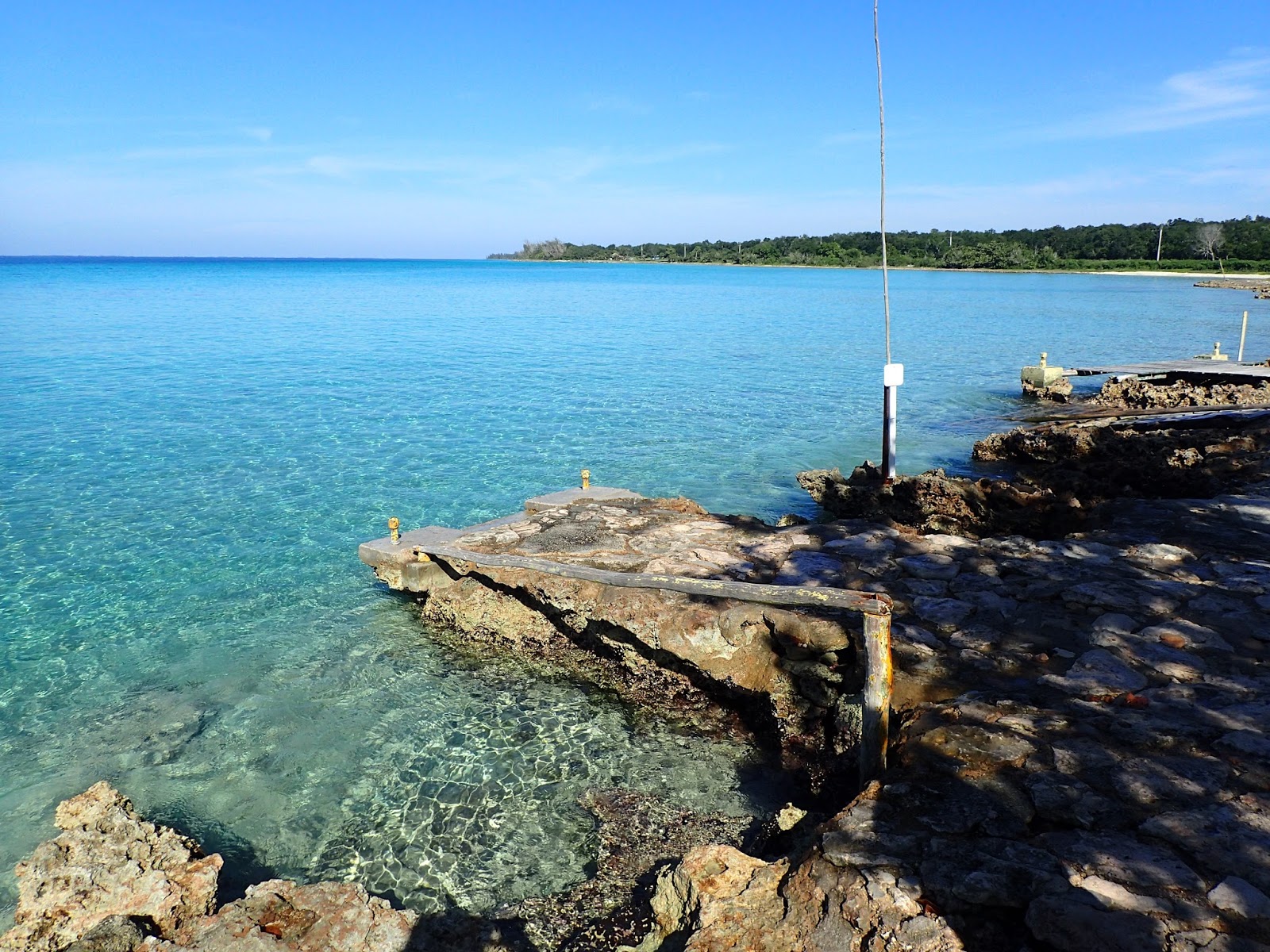
We spent the first few days of our vacation hanging around the resort, the Iberostar Laguna Azul, and soaking up the sun on the beach.  Although there wasn't a reef near our hotel, the snorkeling was surprisingly good just offshore.
The Iberostar Laguna Azul
A panoramic shot of the resort
There were lots of these Cushion Sea Stars just offshore from the resort
This large anchor was attached to a massive chain.  The whole thing was acting like an artificial reef as there were dozens of fish all around it!
These Bluestriped Grunts were just one species hanging around near the anchor and chain
Jeff holding a True Tulip Snail
Sand Diver
Yellow Stingray
One evening we hopped in a taxi and headed into Varadero.  Being a resort town, one of the biggest in the Caribbean to be exact, means there are very few locals.  The town is filled with shops, restaurants, and bars and is very safe to visit.  We heard a rumour (please keep in mind this is unconfirmed) that to keep tourists safe the entire area of Varadero is actually off limits to Cuban locals unless they have a reason (ie: their job) for being there.  We spent the evening bar hopping and exploring the area.  Personally I would like to be in an area where locals are allowed to go so I can get a better understanding of the local culture.
Enjoying a pre-drink at the resort before heading into Varadero
Beers on the patio of El Rancho Restaurant
These generous shots of rum were literally cheaper than water!
Jeff and Sarah on a bridge in Josone Park
Setting Sun
Che Guevara's likeness can be seen across the country as a revolutionary symbol
We took one of the convertible classic cars back to the resort
After a couple of days on the resort we travelled west to the capital city of Havana.  Havana is a 500-year-old city and is approximately 145km from Varadero.  While Varadero is strictly a tourist destination, Havana is a bustling urban centre filled with history.  
We stopped at the Bacunayagua Viewpoint, which was essentially a tourist trap!
There were dozens of these Turkey Vultures flying around
Christine and I taking in the view
The view was pretty good.  You could see mountains in one direction and the ocean in the other.
Our first stop was the Nacional Hotel, a luxurious hotel located on the Malecón on top of Taganana Hill only a few metres from the ocean.  The site offers spectacular views of Havana's Harbour, the seawall, and the rest of the city.  The hotel opened in late 1930 and was a popular attraction for high-profile guests such as artists, actors, athletes, and writers.  Later the hotel became synonymous with American mobsters like Lucky Luciano and Meyer Lansky and was the site of the infamous mob summit in 1946, which was dramatized in the film The Godfather Part II.
The Nacional Hotel as viewed from the front
The backside view of the hotel
There were Peacocks roaming around the hotel grounds
Looking out into the courtyard
Located on the grounds of the hotel are remnants of the Cold War.  A series of underground tunnels and bunkers, called Cueva Taganana, were created prior to the Cuban Missile Crisis in 1962, when the world was believed to be on the brink of nuclear war.
Entrance to Cueva Taganana
A set of old military binoculars
Heading deeper underground
Jerry standing in one of the trenches
After leaving the hotel we headed for Revolution Square, the site of many political rallies and where Fidel Castro and other important figureheads have addressed Cuban citizens.  The north side of the plaza features the José Martí Memorial; a memorial to the Cuban hero who, through his writing and political activism, became a symbol of Cuban independence against Spain.  
Jose Marti Memorial on the north side of Revolution Square
Many of the cars in Cuba are pre-1960 classics!
The southern side of the plaza, opposite the memorial, are the offices of the Ministry of the Interior and the Ministry of Communications.  Each building is adorned with the steel facade of deceased Cuban heroes of the Cuban Revolution.  The Ministry of the Interior features Che Guevara with the quotation, "Hasta la Victoria Siempre" (Until the Everlasting Victory, Always).  While the Ministry of Communications building features Camilo Cienfuegos with the quote, "Vas bien, Fidel" (You're doing fine, Fidel).
Ministry of Communications building with Camilo Cienfuegos' memorial
Ministry of the Interior building with Che Guevara's memorial
Our final stop was in Old Havana.  Here we were allowed to explore the core of the original city of Havana.  We quickly found a place to eat and then explored the busy streets that were filled with shops, pubs, restaurants, cafés, vendors, and more.  
El Capitolio - The National Capitol Building
The National Capitol Building was the seat of government until after the Cuban Revolution in 1959 and is now home of the Cuban Academy of Sciences.  The building was completed in 1929.
The Great Theatre of Havana's first presentation was way back in 1837
More classic cars
The National Museum of Fine Arts of Havana
Central Park statue of Jose Marti
Busy street in Old Havana
Ernest Hemmingway, the famed writer, spent seven years in Havana in the 1930's.  One of his favourite pubs was La Floridita.  Today the bar is popular with tourists (including us) and has a famous daquiry that they claim is the best in the world!  Hemmingway's bar stool is protected by a velvet rope and there's a statue of the writer standing nearby.
Statue of Ernest Hemmingway in La Floridita
A colourful street in Old Havana
Cathedral Square
The Cathedral of the Virgin Mary of the Immaculate Conception, also known as the Cathedral of Old Havana, is one of eleven Roman Catholic churches on the island.  This one was completed in 1777.
Parade Square
Old Havana
Rooftop view from the Hotel Ambos Mundos
Old Havana
Looking down on the city
Christine and I
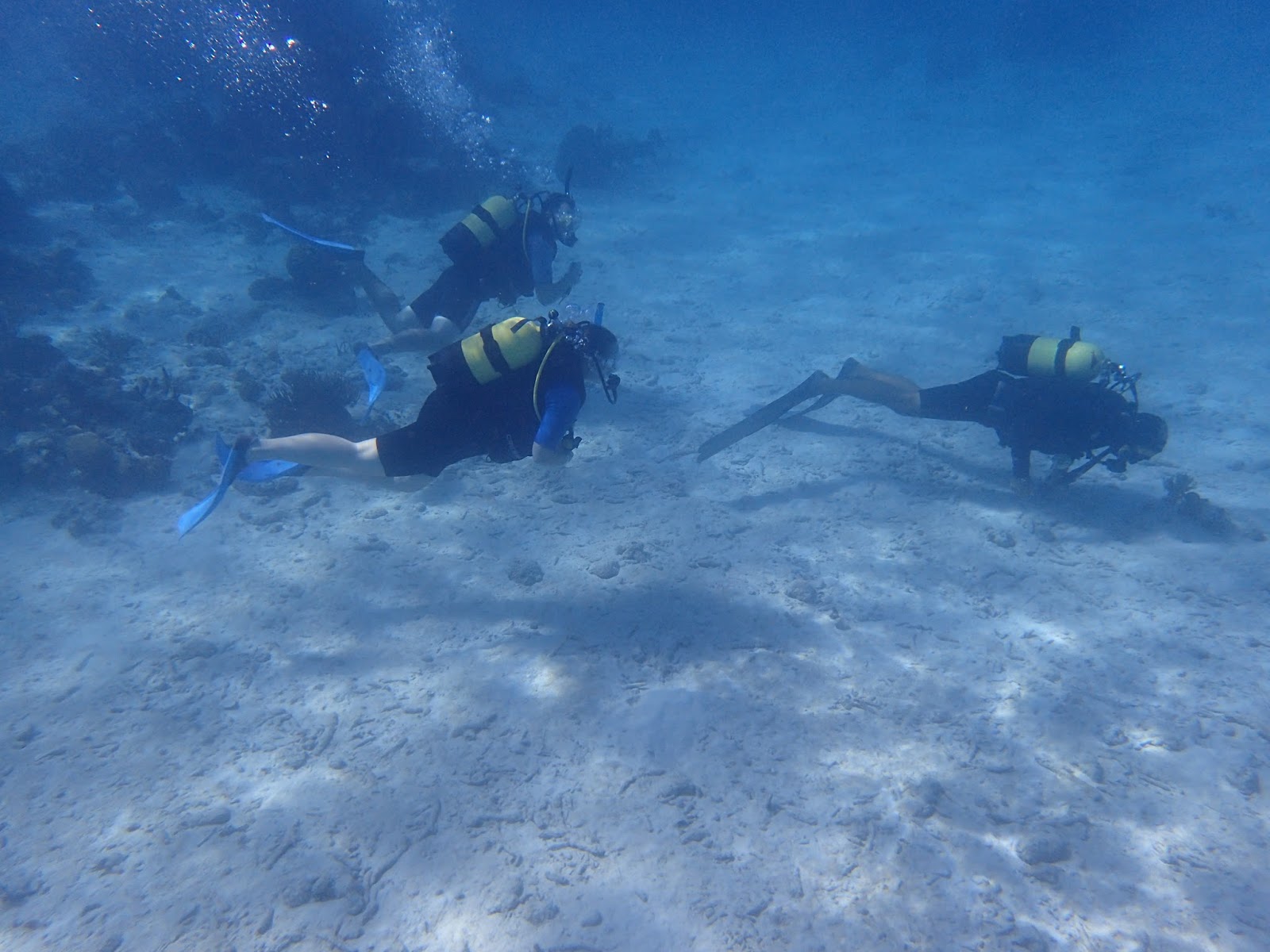
The day after exploring Havana four of us jumped in a van and headed south to the Bay of Pigs for some snorkeling and SCUBA diving.  The bay is located on the south coast of Cuba along the Gulf of Cazones.  The drive was approximately two hours from our hotel and allowed us to see even more of Cuba's countryside.  The area is famous for the failed Bay of Pigs Invasion that occurred on April 17, 1961.  Brigade 2506, a CIA-sponsored paramilitary group aimed at overthrowing Castro's increasingly communist government, was quickly defeated by the Cuban Revolutionary Armed Forces within three days of landing on the island.  Today there are still machine-gun bunkers and other remnants from the short-lived battle on display throughout the area.  
Bay of Pigs
Panoramic shot of the diving and snorkeling area
Gearing up for our dive
Christine and I with dive master Hector
Jerry and Rosemary snorkeling on the surface
Christine
Christine with the sunken landing craft below her
A short video compilation of our dive in the Bay of Pigs

The diving and snorkeling was in an area that was protected from fishing, which meant the reef was in great shape and the fish were quite large.  There was a small boat that was sunk during the Bay of Pigs Invasion on the bottom and a set of wheels that had been attached to a machine-gun nearby.  
After our dive there was still plenty of time for some snorkeling.  This is a Needlefish.
Wheels that were previously attached to a machine gun
Porcupine Fish
Chubs
Queen Conch
Before heading back to the resort we stopped for lunch at Ismary Restaurant; a family-owned operation
We were treated to an incredible traditional Cuban meal, complete with lobster, crab, chicken, crocodile, rice, beans, salad, and freshly squeezed mango juice!
Christmas time in Cuba
Playing with Sarah's new selfie-stick!
This is Allain and he was our bartender/server for most of the week.  He was awesome and seemed to enjoy shooters even more than any of us!!
Jeff and Sarah
Allain and I enjoying another shot!
Unfortunately the next couple of days were plagued with wind, rain, and cool weather.  The red flag was flying high, indicating the beach was closed, so we had to find something else to do.  We hung around the resort, hoping the weather would break and the sun would come back out, which it never did.  We spent most of the day reading and relaxing in the hot tub...with a drink or two!
Miserable day on the beach
Japanese a la carte restaurant
Evening drinks in the lobby
The next day, when the weather was the exact same, Christine and I walked to the nearby Varahicacos Natural Park to do some exploring.  We first stopped at Ambrosio Cave, an important archaeological site (one of 15 discovered) on the Hicacos Peninsula.  Ambrosio is home to several thousand bats, which can be seen and heard throughout the cave...definitely not Christine's favourite!  There are also traces of pre-Columbian inhabitants that give clues to the island's indigenous population.  The cave contains 47 cave paintings, or pictographs, that were painted in both red and black.  The cave is approximately 250m long and contains five interconnected galleries that are all easily accessible, provided you have a flashlight!  During colonialism the cave was also used as a refuge for runaway slaves.
Ambrosio Cave
Entrance to the cave
Fruit Bat
Of the five species of bat that can be found in the cave, the Fruit Bat is one that doesn't mind the spotlight!
Just one of the 47 pictographs that can be seen throughout the cave
Pictographs
It is unknown what the different pictographs mean
Inside the one of the cave's five main chambers
Christine happy to see some daylight!
Cave Selfie
A short video showing a few of the cave's resident bats!

Next we made our way over to Los Musulmanes' path, an interpretive trail that offered a wide diversity of flora and fauna that are native to the area.  The short (approximately 2km roundtrip) out-and-back trail wound it's way through the forest, highlighting many of the natural features along the way.
Main entrance to Varahicacos Ecological Area...The Other Varadero!
A small bird perched on the side mirror of a scooter
Termite Colony
A close-up example of the rocky terrain that we were hiking on
Just one of the many unique trees in the forest
There was another cave along this trail.  It was much smaller than Ambrosio, but there were still bats inside!
Vines and roots growing into the cave from above
This aboriginal burial site was found in 1985 and is over 2,000 years old.  The skeleton was found buried with ornaments and utensils, but was the only body found in this particular cave.
This pool smelled of sulfur
A wooden boardwalk leading to the lagoon's viewpoint
Celebrating Christine's 30th birthday at one of the a la carte restaurants
Enjoying a drink with our new friends from Switzerland
These curly-tailed lizards were all over the resort
A couple of lizards sunning themselves on a rock
The morning of our last day in Cuba.  The sun was shining and we were finally able to take one last swim in the ocean.
Although we had a great vacation, I didn't seem to enjoy Cuba as much as other countries I have been to before.  The first question most people ask is, "how was the food?"  I'm happy to say that the food wasn't nearly as bad as some people make it out to be, but it was pretty repetitive after awhile.  I thoroughly enjoyed Havana and would have liked to have spent more time there as opposed to the resort community.  I am really happy we went, but I don't know if I'm in a big hurry to go back.  There are just so many other places in the world to see!