Showing posts with label Cochrane. Show all posts

Wednesday, March 29, 2017

Glenbow Ranch Provincial Park

Trip Date: March 2017


Glenbow Ranch Provincial Park
Take a step back in time and discover some of Alberta's earliest frontiersmen at Glenbow Ranch Provincial Park. The Canadian Pacific Railway (CPR), in their ambitious quest to span the continent, continued their westward push reaching Cochrane in the fall of 1883, opening more of the Canadian west for settlement, ranching, and industry. Due to the fact all trains at that time were steam powered, water was a necessary component for operation. In 1889 the Glenbow Valley immediately east of Cochrane was selected for a water tank and a section house. This land originally belonged to the Cochrane Ranche, one of the most ambitious cattle ranching experiments of the late 1800's. By 1903 the CPR had established a station and laid additional track that ran parallel to the mainline, known as siding. Then in 1905 the small, but growing community of Glenbow became a flagstop along the CPR's mainline. This decision provided much-needed passenger and freight services that were sorely lacking for the valley's residents.

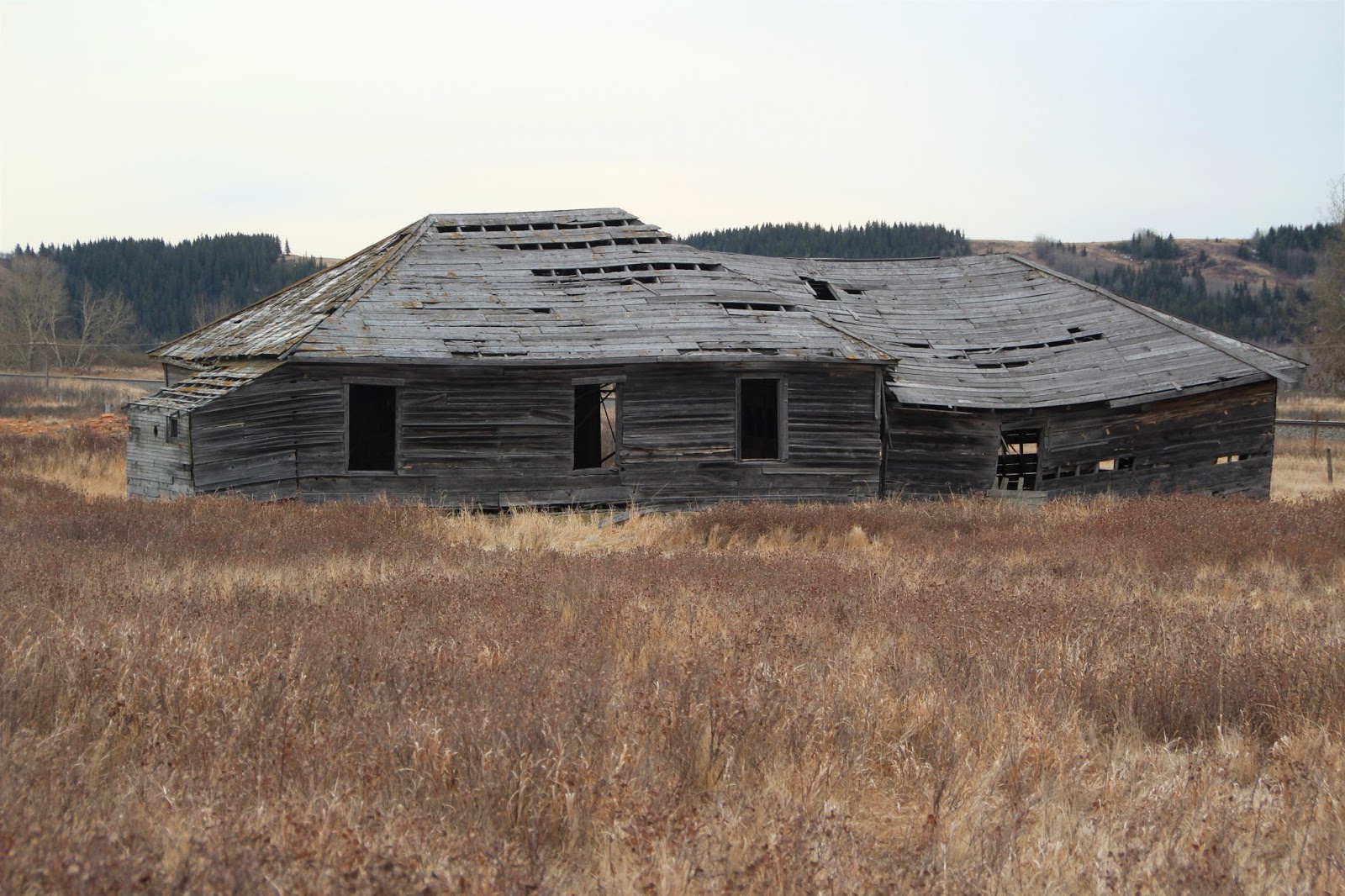
If you look to the east as you enter the parking lot you can see the ruins of the Stevenson home on Millionaire Hill
Looking west towards the Rockies from the viewpoint near the parking lot
Looking east down the valley with the Bow River far below
All that remains of the Morris family home are two chimneys; one brick (above) and one stone (below)
The Morris family lived on Millionaire Hill from 1914 to 1918. The home eventually burned down in 1977, leaving behind only these two chimneys.
The railway was directly responsible for the birth of Glenbow. As early as 1907 men were mining the valuable sandstone in the hills above the town. The sandstone was a sought-after building material. Were it not for the railroad the Glenbow Quarry would not have had access to a market to sell its product and without the quarry the town of Glenbow likely wouldn't have been needed. As the quarry flourished, so too did the burgeoning town. Corrals, a grain elevator, a stock chute, a post office, a general store, and a school were all built to suit the town's growing needs. Wealthy businessmen and their families flocked to the valley, erecting elaborate homes on the hillsides overlooking the town below, which eventually earned the nickname 'Millionaire Hill'.
"We have many visitors at present who are anxious to buy lots for residential purposes, being so close to Calgary, and where the best fishing and sport can be secured easily." 
                               ~Calgary Daily Herald, April 7, 1909
This is the only building still standing from the once thriving town of Glenbow. This is the General Store & Post Office and was originally painted green. Both businesses closed in 1920.
These piles of unused bricks are all the remain from the failed Glenbow Brick Plant
These corrals were built in the 1950's and were upgraded in the 1960's by Glenbow Ranching Ltd.
The Glenbow General Store & Post Office with a backdrop of the Canadian Rockies
Richardson's Ground Squirrels can be seen by the dozen in the park
By all accounts Glenbow was a roaring success. At the height of its prosperity 350 residents called the town home, but alas this success story was to be short-lived. The sandstone, the root of Glenbow's achievements, was discovered to be flawed. Due to present weaknesses to freeze/thaw erosion the sandstone could only be used for the lower sections of buildings and the deeper parts of the stone contained a 'blue hardhead' that was very difficult to work with. Due to these limitations and the frequent break-downs in the quarry's expensive equipment the whole operation closed in 1912, leaving the future of Glenbow quite murky.
"The town of Glenbow situated as it is in the hollow surrounding hills and on the banks of the river Bow, is destined to become a large town, if not a city, in the course of a very few years."                                
                               ~Calgary Daily Herald, July 15, 1909
Crossing the railroad tracks
A section of the Glenbow Trail that eventually ends up in Calgary
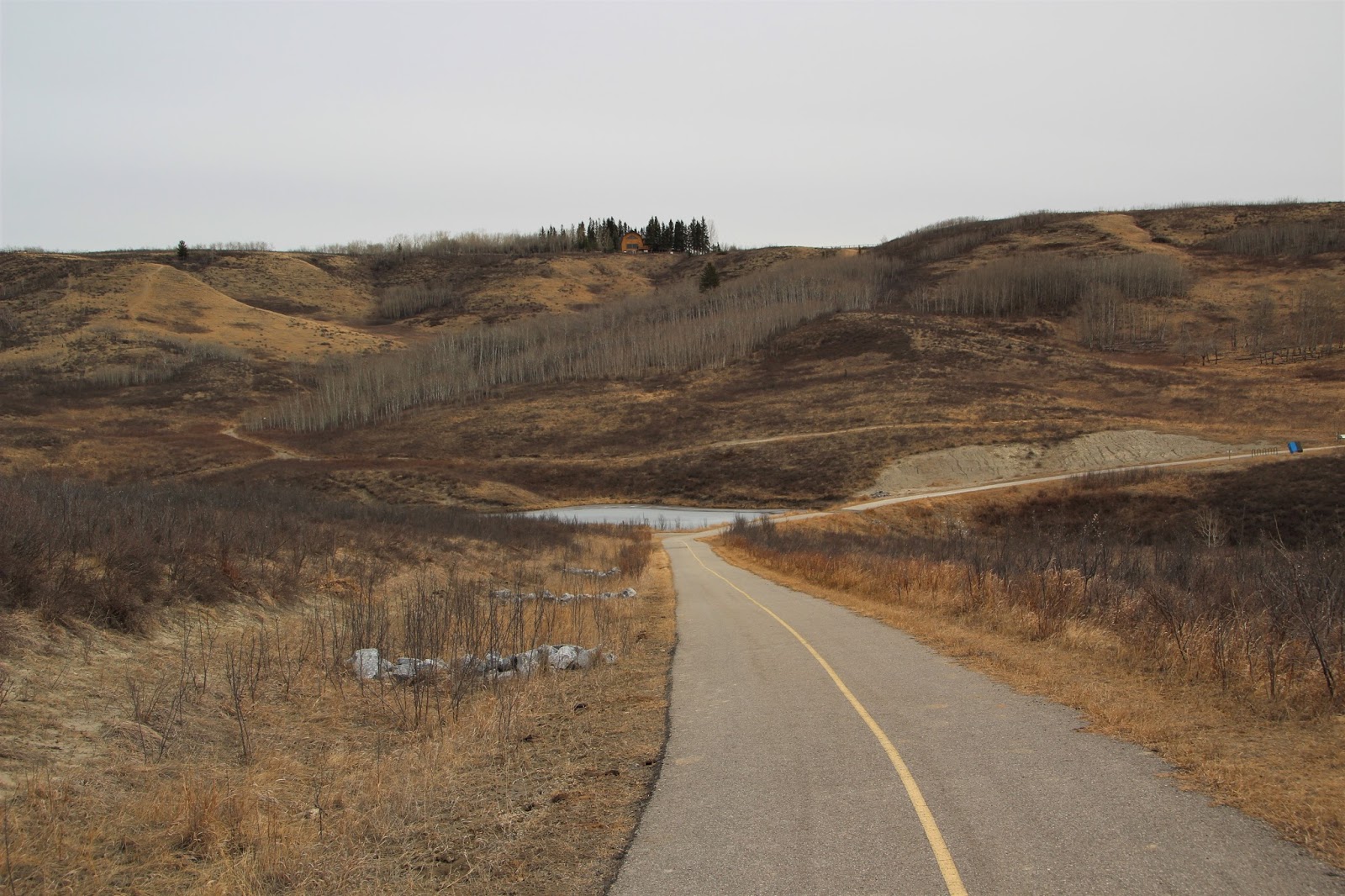
Hiking along the Bowbend Trail with the Park Office at the top of the hill in the background
This stone chimney is the lone testament to the historic Waverley Ranch 
In an effort to combat the quarry's closure a brickyard was established, but it too was shuttered in 1914 due to mounting debt and poor quality product. That year also marked the beginning of World War I and many locals left to join the war effort or to pursue other interests in different locales. The population slowly declined over the years until the last residents moved away in 1927, leaving only industrial relics, a few crumbling foundations, and the long-abandoned general store.

Look at the ears on this Mule Deer that I spotted across the coulee from the Tiger Lily Trail
Hiking the Tiger Lily Trail
Just off the trail are the rusting frames of several cars from days gone by
There is no interpretive sign about these automobiles, so I can only guess how they ended up on the side of this hill
This vehicle is almost completely overgrown
Glenbow remained a private ranch owned by the Harvie family until 2006 when the land was donated to the Government of Alberta and would officially become Glenbow Ranch Provincial Park in 2008. After a $3 million face-lift, which included pathways, viewpoints, fencing, maps, interpretive signs, a railway crossing, washrooms, and picnic facilities, the park officially opened in summer 2011.

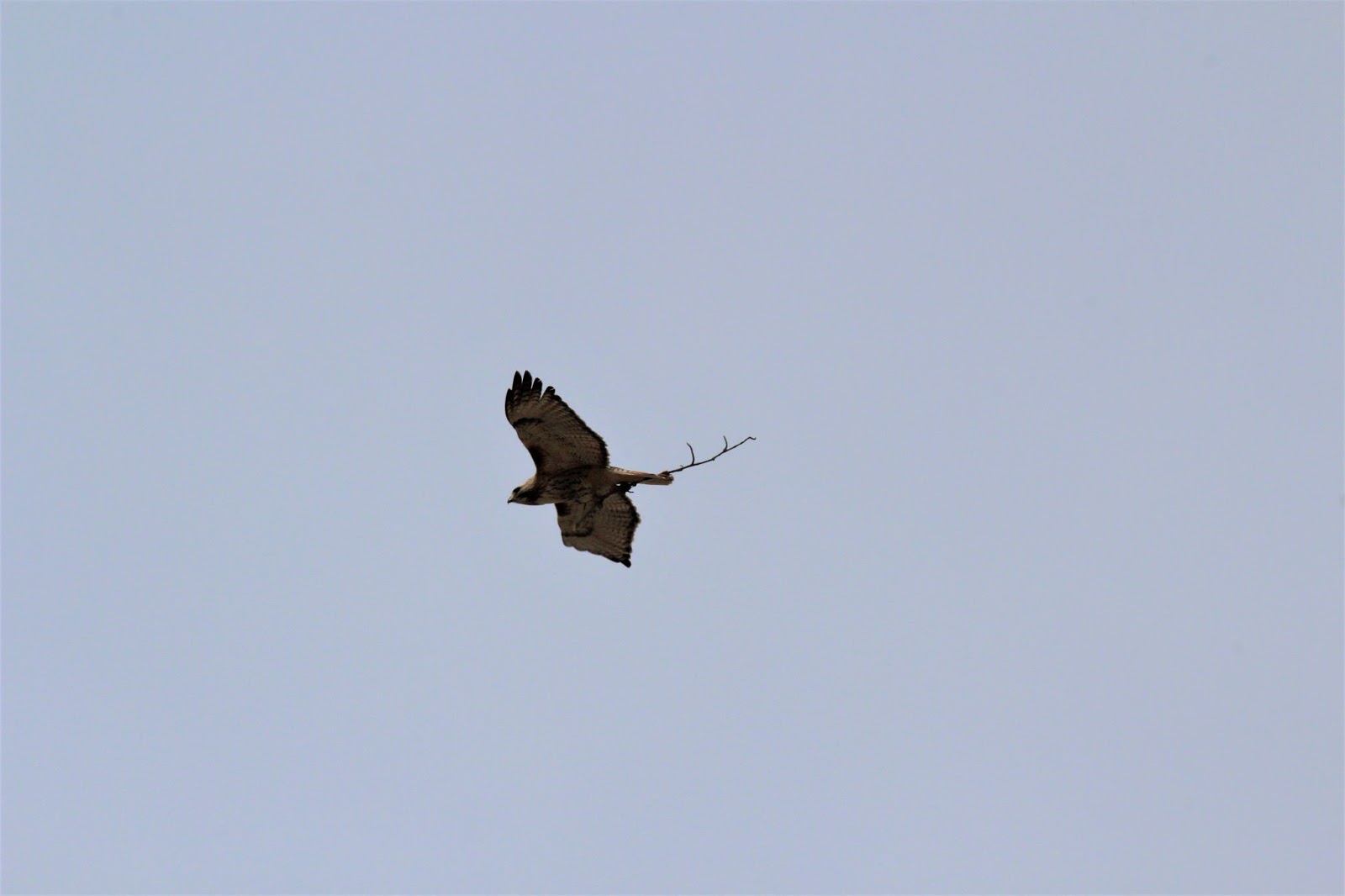
As I was leaving the park I saw this Red-Tailed Hawk soaring in circles while utilizing a thermal updraft
The hawk was carrying some nest material in its talons
The park features more than 25 kilometres of paved and un-paved trails to suit all ability levels. My day consisted of hiking along the Glenbow, Bowbend, and Tiger Lily Trails, which passed many of the park's historical artifacts. I totaled about 12 kilometres over the course of the afternoon, but would love to get back there again sometime soon and see what the rest of the park has to offer.

Thursday, March 31, 2016

Yamnuska Wolfdog Sanctuary

Trip Date: March 2016


The creature had charcoal fur tinged with silver and grey highlights, bright yellow inquisitive eyes glowing among its dark coat, individually controlled ears that stood tall on top of its head; straining to hear every sound, enormous paws, equipped with jet-black nails, attached to impossibly long legs, and a bushy tail held straight-out behind it. It's powerful nose was raised slightly, trying to catch my scent on the cool morning breeze. Unsure what to expect or how the beast would react to my presence I cautiously reached out my hand, exposing a small piece of dehydrated rabbit meat. Having recognized the scent of deceased bunny, the critter approached me revealing a mouth filled with teeth perfectly suited for eviscerating meat from bone. Concerned that my fingers were still clutching the meat currently being eyeballed eagerly, and wanting to leave with the ten digits I arrived with, I immediately second-guessed my decision, but before I knew it the treat had been dispatched from my hand in the most gentle way imaginable; even more gentle than the German Shepherd I share my home with. This, however, was not a domestic dog, but a wolf, more specifically a high-content wolfdog named Kaida, who having consumed the treat was now enthusiastically approaching me in search of another. I never thought I'd be hand-feeding a living, breathing wolf, but such is life at the Yamnuska Wolfdog Sanctuary.

Kaida, a high-content wolfdog, was very interested in all the treats we had and would take them from our hands as gently as could be!

This is Zeus, a high-content wolfdog. He wouldn't nibble treats from our hands, but would get close enough to eat them off the ground after we tossed them in his direction.

The Yamnuska Wolfdog Sanctuary (YWS), founded in 2011 by Georgina De Caigny, is a refuge for abandoned or stray wolfdogs; ultimately saving them from the alternative, which is almost always euthanasia. According to Alberta law, any dog that ends up in a shelter and is reported as a wolfdog cannot be adopted and must be destroyed. As sad as this is the system around which the law was created is flawed. Many breeders misrepresent the animals they are selling in order to fetch a higher price. As soon as you attach the label 'wolfdog' to an animal the cost of purchase increases. In a high percentage of cases the animals being sold are considered low-to-mid content wolfdogs and many don't contain any wolf blood at all. All of this leads to more animals being put-down than is necessary based solely on being misrepresented from the start. Another common misconception is that you can attach a percentage to each animal. Many owners and breeders will state that they have a wolfdog that contains 75% wolf, for example. Unfortunately this is just plain false as genetics don't work that way. There is no genetic test that can determine the percentage of wolf or dog DNA within a wolfdog. As a result the staff at YWS classify their animals as low, mid, or high-content based on physical appearance, behavioural characteristics, mannerisms, and other observable traits, including how they interact with humans. In this way high-content wolfdogs would look and act more wolf-like than a low-content wolfdog, which would be more dog-like on the spectrum.


Rango, the coydog, eagerly approaches the fence after spotting me!

The sanctuary is located in the foothills of the Rocky Mountains approximately 50km northwest of downtown Calgary and just west of the town of Cochrane. I arrived early on a Saturday morning, excited for my guided tour. A very large Malamute cheerfully greeted me as I entered the main office and after meeting several of the staff and signing the required waiver I walked into the sanctuary. Rango, a six-month-old high-content coydog (a mix of coyote and domestic dog), excitedly ran up to his fence to greet me. I'm told that he really enjoys human interaction and I was able to pet him through the fence of his enclosure. Due to his curious nature I had to be careful because he would steal anything not tied down! I had some time to kill before the guided tour began so I wandered from one enclosure to the next viewing the wolfdogs. I was surprised at the variety in appearance and their reaction to my presence. Some looked more like domestic dogs than wolves, while others were dopplegängers of their wild cousins. Some eagerly approached the fence when I arrived, others disappeared into the depths of their enclosure, and others still were completely indifferent to my presence; dozing lazily in the sun.


Nova is another high-content wolfdog that was a little wary of our presence

The time had finally come for us to enter one of the enclosures so we could interact with the wolfdogs. After a quick safety briefing, which included additional reminders not to leave personal items unattended, our guide Forrest unlatched the gate and we all stepped in. We would be meeting the high-content wolfdogs first and any fears we initially had were erased when the wolfdogs scattered throughout the enclosure as we entered. Forrest told us that wild wolves are naturally wary of humans and will try to avoid us if possible. These wolfdogs reacted much the same way as wild wolves would; disappearing into the far reaches of their enclosure in order to observe us from a distance. Of the four animals in the enclosure only two would eventually approach us to nibble on the handful of treats that Forrest provided. The other two would only come close enough for us to toss treats in their direction, using their powerful sense of smell to locate the morsels in the grass. Even though two of them felt comfortable enough to eat from our hands the slightest unexpected movement would cause them to run from us. Even Forrest, who they are familiar with, caused them to flee when he stood to handout more treats.


Nikki is a low-content wolfdog that came to the sanctuary from the Red Deer area. Although she was a feral wolfdog she has now become one of the best ambassador animals for YWS.

There was a stark contrast in behaviour when we entered the low-content wolfdog enclosure. Here the wolfdogs were eagerly looking at our hands anticipating the possibility of treats, whereas the high-content wolfdogs were constantly looking at our faces. The majority were much more tolerant of our presence; hounding us for treats and back scratches. They were more aggressive taking the treats from our hands, much like an excited domestic dog would be. Their physical appearance was more dog-like than the high-content wolfdogs; some even resembled dogs that'd you see at an off-leash park in Calgary. One was even wearing a collar! Their was an air of excitement and rambunctiousness that the high-content wolfdogs did not possess.


This is Manowar, a low-content Saarloos wolfdog all the way from Europe. He will be staying at the sanctuary while his family completes the process of moving to Canada.

The low and mid-content wolfdogs are available for adoption through YWS, but it's very important to understand what you're getting into. They don't make great pets and can be infinitely more challenging than a domestic dog. In fact De Caigny often tells potential adopters that the wolfdogs are actually more like cats because they only do what they want to do when they want to do it! They require continual work, specially-designed enclosures to prevent digging or jumping out, and restricted diets. Since most people aren't willing to undergo such a challenging task the role of the sanctuary becomes even more meaningful, especially when you consider the alternative for many of its residents. The thought of having a pet that is part wolf sounds pretty cool to many people, but the reality is they are difficult animals to have as pets and many people give them up because they can't handle the challenge.


Rue is also an excellent ambassador animal for YWS and is a wonderful representation of an upper-mid-content wolfdog

Wolves have long been one of the most polarizing creatures in the world. Almost hunted to extinction across North America, they were eventually placed on the endangered species list and have since made a steady recovery, but only inhabit a fraction of their former range. The problem could be rooted in misinformation and preconceived notions about wolves that are not based on fact. Much like the Northern Lights Wildlife Wolf Centre in Golden, BC, the Yamnuska Wolfdog Sanctuary aims to educate visitors about their misunderstood residents with the hope of creating a better relationship between wolf and man.


Horton is a low-content wolfdog and part Irish Wolfhound. Due to a long history of abuse and neglect he is very untrusting of humans and typically retreats to the depths of his enclosure to avoid them.

I am happy to report that I left the sanctuary with all of my appendages securely intact! But I also left with newfound respect for these misjudged animals and the people caring for them. If they were bloodthirsty, mindless killers I would have been shredded the moment I stepped foot into their enclosure, but instead I found cautious animals that appeared to be more afraid of me than I was of them. YWS is a wonderful place to learn more about wolves and wolfdogs and hopefully put to rest some of the misguided and fictitious information that's out there. At the end of the day it doesn't really matter where the dog ends and the wild begins, just that they deserve your respect no matter what.


Kuna is another high-content wolfdog. Although she would eat from our hands she was more interested in napping in the sunshine!
This story was also featured on the Calgary Guardian website under the name, Howl For The Wolfdogs. I also wrote a story about the wolf centre in Golden called, Walking With Wolves and a blog post on the same topic, which can viewed right here


Friday, September 6, 2013

Cochrane Ranche

Trip Date: August 2013


I drive by the Cochrane Ranche Historic Site twice each week; once on Monday morning on my way out to work and again Thursday afternoon when I'm on my way back home. I'd never stopped in to see it in person, but I was dogsitting in August for a co-worker who lives in Cochrane and took that opportunity to go and see it for myself. I'd also heard a rumour that there was a single pictograph located somewhere on the land owned by the Cochrane Ranche and wanted to see if I could find it.  

The Cochrane Ranche is located approximately 40km northwest of Calgary along Highway 1A in the town of Cochrane. The ranch was established in 1881. An informative sign near the parking area gives this background about the site.
This is the site of one of the most adventurous cattle ranching experiments undertaken in the 1880's. Senator Matthew Cochrane, an Eastern cattle baron, anticipated success as the 100,000 acres of lush prairie grasses and countless creeks and rivers made for ideal conditions. In 1881, 6,800 exhausted cattle arrived here from Montana after a rushed drive. 
Disaster followed as the first two winters proved to be unusually harsh. The Chinook Winds did not bring the expected relief lasting only long enough to partially melt the snow which froze again forming a hard crust over the range. Two thousand head of cattle starved to death unable to get to the grass lying just inches below their hooves. 
Through mismanagement and unforeseen bitter climatic conditions the site as a cattle ranch was short lived. In 1884 the remaining cattle were moved to the Waterton Lake area and the ranche was stocked with sheep. This venture was also plagued with misfortune and by 1889 most of the ranche's holdings were sold off. 
On May 21, 1979 the Cochrane Ranche Historic Site was officially opened with the unveiling of the Men of Vision Statue.
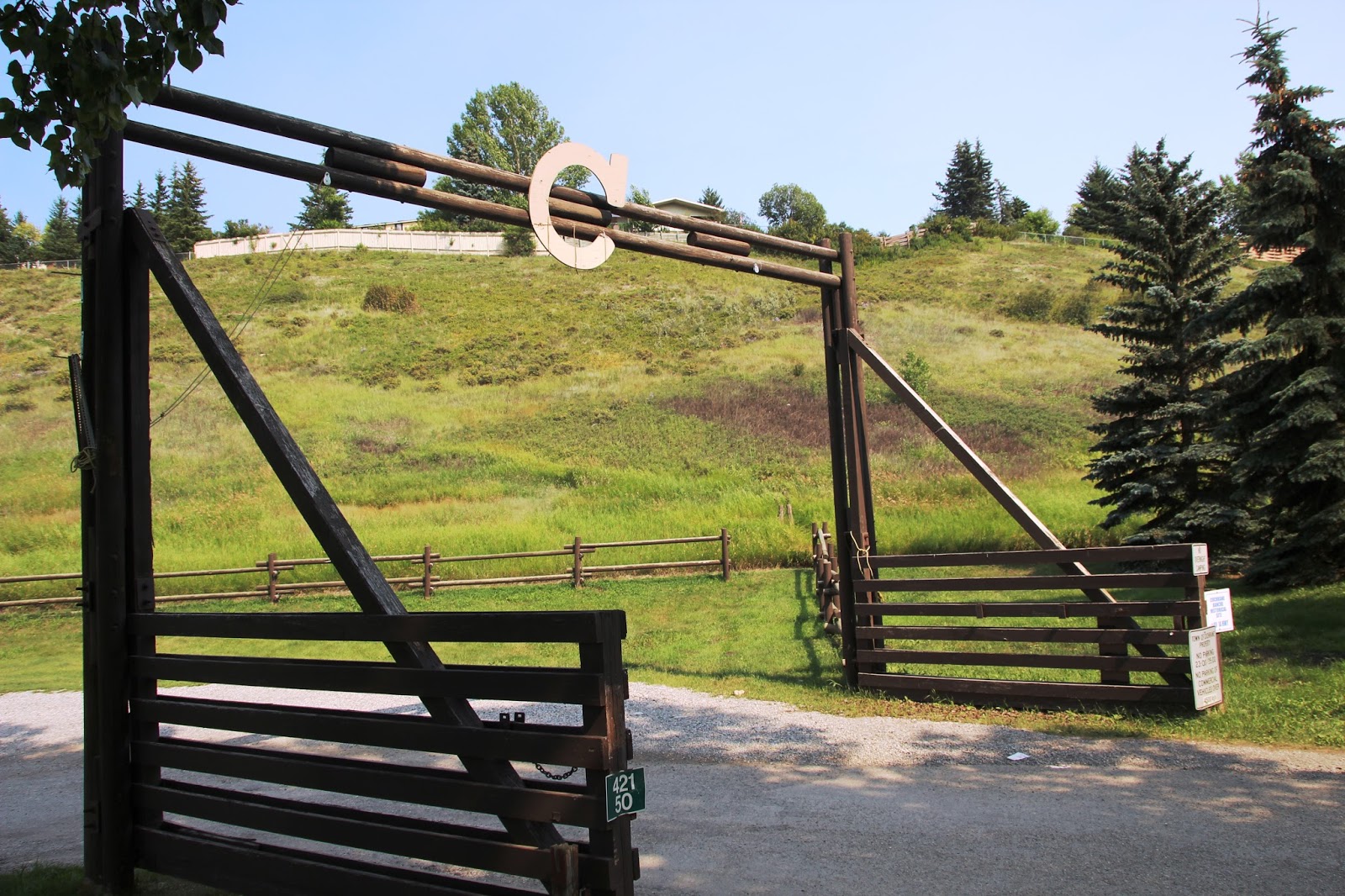
Entrance to the Cochrane Ranche
A large "C" adorns the gate
The Westerson Cabin was built in the mid 1920's and was first used as a tourist stop for those travelling between Calgary and Banff and was known as "The Tourist's Rest". In 1931 the tourist business wasn't as profitable as hoped and the building was sold. It then became a Union Oil Service Station, which later expanded into a trucking and shipping business. In 1942 the cabin was sold to Carl Westerson. The Westerson family made their home in the building for 36 years until the deaths of Carl and his wife in 1978 at which time their children donated the cabin to the Town of Cochrane. In 1984 the cabin was moved closer to the centre of town and was then used as a Tourist Information Centre and a small museum. In 1998 the cabin was moved to its present location at the Cochrane Ranche Historic Site.

The Westerson Cabin is now the Cochrane Ranche's information centre
I hiked Stockman's Trail through the ranche site. This is the corral.
Big Hill Creek flows through the ranche
Another look at the corral
Former site of the Bunkhouse. The Manager's House was immediately to the left, but nothing remains there.
Looking up towards the Men of Vision statue
Malcolm J. MacKenzie's 1978 Men of Vision statue was commissioned by Alberta Culture for the Cochrane Ranche Historic Site. It was to commemorate the working cowboy of early ranching days and was unveiled May 21, 1979.  
"Men of vision guard the trust, this land so much desired to whom much is given the more will be required. God gave stout hearts to the pioneers, their legacy to you, change and progress, hand in hand, twas thus Alberta grew."  
Ray Bagley
Alberta Pioneer
Men of Vision
The Cochrane RancheHouse also sits on the ranch site. The RancheHouse is home to a multi-purpose conference centre, the Cochrane administration offices, the Mayor and Council offices, Council Chambers, recreation programs, and the Stockmen's Memorial Foundation.
With a little help I was able to find the site of the lone pictograph located at the Cochrane Ranche. I was also pleasantly surprised to find out that directly beside the pictograph was also a single petroglyph, or rock engraving, that I did not know was there!

This petroglyph depicts the sun
Although difficult to see, this pictograph is of a shield-bearing warrior
You can read more about the pictograph and petroglyph sites I have visited by visiting my Western Canadian Rock Art section on the Bradshaw Foundation's webpage.