Showing posts with label Fossils. Show all posts

Sunday, July 31, 2016

Burgess Shale

Trip Date: July 2016


"The Burgess Shale is not unique, but for those who study evolution and fossils it has become something of an icon. It provides a reference point and a benchmark, a point of common discussion and an issue of universal scientific interest." 
          ~Simon Conway Morris, Paleontologist

I spotted this Elk on my early morning drive to the trailhead. There were also two Pine Martens around the next corner, but they were both camera shy!
The trailhead for the hike is Takakkaw Falls, one of the tallest waterfalls in Canada. In the Cree language 'Takakkaw' means 'It Is Magnificent'; can't argue with that!

My shoulders were burning with the weight of my pack. Sweat was rolling down my face, stinging my eyes. My lungs were working overtime from the last steep push to the top. But even with all my bodily discomfort those final paces were significant as they followed in the exact footsteps of Charles Doolittle Walcott, the man responsible for discovering the Burgess Shale. The soreness seemed to just melt away as I caught my first glimpse of the famous fossil bed. My sole purpose for being 2,286 m (7,500 ft) above sea level, perched on the side of a mountain ridge was this exact spot; Walcott's legendary quarry. It took only a matter of seconds for my eyes to spot a lone fossil peeking out from among the broken shale and from that point I was hooked.

On the trail with Wapta Mountain in the background
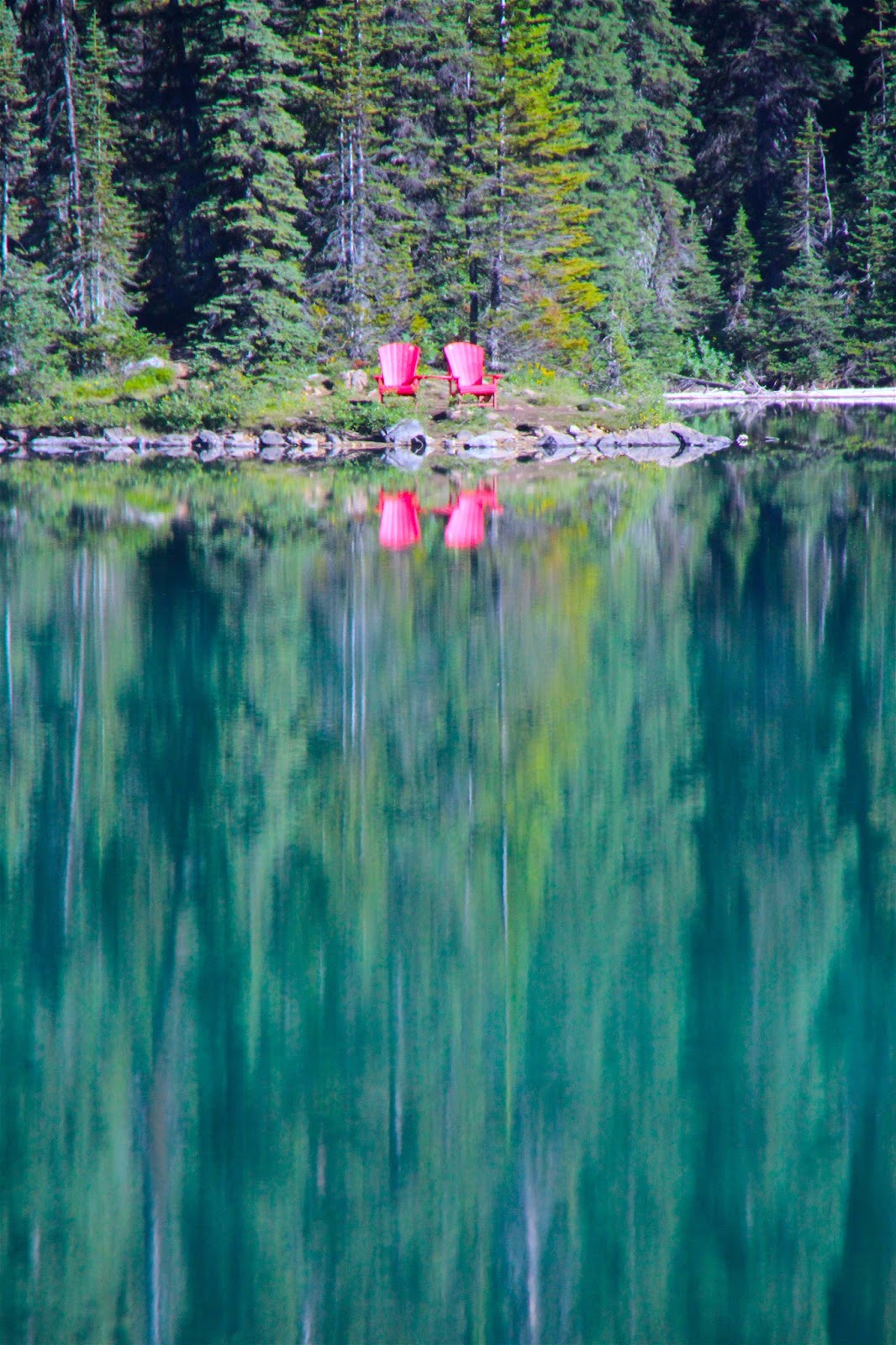
The hike passes two sets of red Adirondack chairs, which are part of Parks Canada's Red Chair Program. The first set is near Takakkaw Falls, while these two are on the shoreline of Yoho Lake.
Yoho Lake with a superb view of Wapta Mountain
You can read all about the Red Chair Program by visiting the Calgary Guardian website and reading my story titled, Share The Chair.

The Burgess Shale has been called one of the most important fossil discoveries anywhere on the planet. The fossils found there are over 505 million years old and are some of the finest examples of soft-bodied preservation anywhere on Earth. Most fossils on record contain hard body parts, such as bones, shells, and teeth, but the ones discovered in the Burgess Shale also contain mineralized soft tissues allowing us to see the entire organism completely preserved. Half a billion years ago the geography that is now Yoho National Park was very different. There was no British Columbia, no Canada, not even a North America. The entire area was under the ocean and all life on our planet resided below the surface. The exceptional fossils of some bizarre looking creatures include some of the oldest known relatives of many species still alive today. These primitive creatures lived near the muddy sea floor. At different times these animals would be caught in underwater mudslides, becoming buried in deep water away from scavengers. The mud and silt that entombed them was so fine it was able to settle between each curve and crevasse of the organism's body. Additional layers of mud and silt were deposited on top, slowly flattening the entrenched animals. Over time and through various geological processes the mud and silt hardened eventually becoming shale; preserving the trapped inhabitants for eternity.


Our first view of the President Range with Emerald Glacier perched on the summit
Emerald Glacier
This Hoary Marmot was basking in the sunshine
Emerald Lake as view from our lunch spot
This Golden-Mantled Ground Squirrel was looking for handouts
A Golden Eagle soaring on thermal updrafts

Like champagne bubbles, Viagra, and Velcro, the Burgess Shale was also discovered accidentally. In the late 19th century as the Canadian Pacific Railroad (CPR) was moving westward through the difficult Kicking Horse Pass region, one railroad employee found what he described as "stone bugs" on the steep slopes of Mount Stephen. Those "bugs" turned out to be Trilobites and there were millions of them. The stories of the stone bugs eventually made their way to geologists from the Geological Survey of Canada (GSC), bringing scientists out west to study the site, collect specimens, and publish reports about their findings. One of those reports caught the attention of Walcott, a fossil enthusiast and Secretary of the Smithsonian Institution, although he didn't visit the famed Trilobite bed until 1907, a full 20 years after first reading about it. Two years after his initial visit Walcott was back in British Columbia in search of more fossils, but here's where history gets a little murky. While riding his horse on a high trail between Wapta Mountain and Mount Field, Walcott encountered a large rock in his path. He was either bucked off his horse or got off his horse to move the boulder out of the way. However he got off his horse isn't as important as what he discovered while on the ground. Had he not dismounted his horse that fateful afternoon the small fossil he found would have likely gone undiscovered awhile longer. That early specimen would become the first of many collected from Walcott's Quarry in the Burgess Shale, so whichever version of history you prefer, it was a defining moment either way. Walcott and his family would spend at least a portion of every field season in the Canadian Rockies from 1907 to 1924, uncovering new organisms, many of which were previously unknown to the scientific community. It was Walcott that determined the fossils were from the Middle Cambrian age, making them over half a billion years old. Throughout his time in the Rockies he would identify many new species and provide expertise on the area and its prehistoric organisms. By 1924 Walcott assumed he had exhausted his quarry and didn't return the next year. Unfortunately he died in 1927 leaving the 65,000 fossils he collected all but ignored for the next 40 years. Ultimately his collection would become one of the jewels of the Smithsonian Institution's permanent collections at the National Museum of Natural History in Washington, D.C.


Entering the restricted area, so we must be close!
The final push to the top. That's Mount Burgess on the right.
Sign marking the entrance to the quarry


At first glance Walcott's Quarry doesn't look like much, but hiding amongst all that shale are countless creatures just waiting to be discovered!
This is an example of a well-preserved Ottoia, a worm-like species that was carnivorous and lived in the sediment on the sea floor

Today the Burgess Shale is completely off-limits to the public; protected within the UNESCO Canadian Rocky Mountains World Heritage Site. Guided tours are offered throughout the summer by the Burgess Shale Geoscience Foundation and Parks Canada, which is how I ended up there. The hike itself is 22 kilometres round-trip with 800 metres gained in elevation. We were on the trail for 10.5 hours moving at a leisurely pace. The trail passes picturesque Yoho Lake, crosses Yoho Pass, and offers spectacular views of Emerald Lake and surrounding peaks, but the main attraction is definitely the fossil bed. Despite Walcott's assumption we know his quarry is still providing fossils to those with patience and keen eyesight. Easily the best part of the tour is digging through the shale in search of undiscovered prehistoric creatures, just as Walcott himself had done all those years ago. With a little luck you're sure to uncover critters not seen for many years, maybe ever!

How many fossils can you see in this photograph?
Here's an example of Vauxia, a type of sponge. Walcott named this creature after his third wife Mary Vaux.
These are the two almost complete specimens I found in the quarry. Both are most likely Olenoides as they're typically the most well-preserved Trilobites.

The statistics for the hike may seem daunting at first, but aren't actually that bad. Yes the hike is considered difficult. It's the equivalent of climbing all the stairs in a 234 story building both ways, but our guide did an incredible job of keeping a relaxed pace that included numerous stops for rest, water, and snacks. Throughout the day our guide entertained us with informative chats about the formation of the site, the history of the area, and the significance of the discovery. Our group of 12 ranged in age from as young as 19 up to and including retirees, all of whom safely completed the trek. We were treated to perfect hiking conditions complete with a blue bird sky and ample sunshine. We couldn't help but comment on the weather as the entire area has seen almost daily rain storms leading up to this tour.

An extremely well-preserved Trilobite fossil with Emerald Lake far in the background
Me standing in Walcott's Quarry holding a fossilized Trilobite
Mount Burgess (left) and Emerald Lake as viewed from the quarry
The smile on my face says it all!

We spent just over an hour in the quarry and that time passed by incredibly fast. I was able to find several fossils, including two Trilobites that appeared to be complete specimens. It's difficult to know for sure whether those fossils had previously been seen by human eyes. I like to think that I was the first to discover those small relics of the past, further deepening my newfound connection to Walcott. But before I knew it we were back on the trail, headed for home. There was a noticeable absence of conversation after leaving the quarry. Perhaps everyone was reflecting on the memorable experience or maybe the adrenaline had now subsided and we were left with the sudden realization that we had a long slog back to the trailhead. Whatever the reason for the silence this guided excursion had provided me with memories and photographs that would last a lifetime.


One final glace towards the Burgess Shale from the publicly accessible trail as we begin our descent

To reserve your spot on an upcoming guided hike to the Burgess Shale please visit the Yoho National Park website. You can also follow them on Twitter and Facebook in order to stay completely up to date with everything happening in the park. For an in depth look at the Burgess Shale, including a virtual submarine tour of the underwater community, please visit the Royal Ontario Museum website. In closing I'd like to thank Karin Smith for putting this whole trip together and Kristi Beetch, our remarkable guide, for getting all of us to the site and back safely while making the day engaging and meaningful. Thank you both!


The hike starts and stops at the same spot; Takakkaw Falls!

To read about my other forays into Yoho National Park please visit my previous blog posts titled,Yoho National Park: MonarchYoho National Park, and Emerald & Hamilton Lakes. You can also read this story in several other places including the Calgary Guardian (Yoho's Stone Bugs), and GOT Parks (Yoho's Stone Bugs).


Saturday, July 16, 2016

Devil's Coulee

Trip Date: July 2016


The Devil's Coulee Dinosaur & Heritage Museum is located in the village of Warner; approximately 280km southeast of Calgary. Devil's Coulee is an important paleontological site as it's Canada's first, and largest, dinosaur nesting site. The coulee was originally called Fossil Coulee but the name was changed when local ranchers started referring to it as Devil's Coulee because the three valleys that makeup the coulee resemble a devil's trident when viewed from the air. In 1987, after a tip from local woman Wendy Sloboda, paleontologists from the Royal Tyrrell Museum arrived and made an exciting discovery; a tiny embryonic femur and fragments of eggshells. Kevin Aulenback, a Tyrrell Technician, followed the trail of eggshell fragments, which eventually lead to a small batch of fossilized dinosaur eggs on what is now known as Little Diablo's Hill. Since that initial find various species of dinosaur eggshells have been found, as well as embryonic skeletons, and sub-adult bones.

Welcome to Devil's Coulee Dinosaur & Heritage Museum
The outside of the museum in the village of Warner
The museum tells the story of this important fossil site and showcases several specimens that have been found over the years, including the museum's crown-jewel, Charlie! Charlie is the most complete embryonic dinosaur ever found in North America. Charlie is a duckbill Hadrosaurus dinosaur belonging to the Hypacrosaurus stebingeri species. Charlie has allowed researchers to unlock additional evidence about some of the Hadrosaur species that resided in southern Alberta, such as their egg size (approximately the size of a volleyball), length prior to hatching (approximately 45cm or 18in), and whether their parents played a role in raising them. The current theory is that after laying their eggs the mothers abandoned the nest. Charlie is equipped with a mouthful of teeth meaning he wouldn't have needed his mother to chew/provide food for him and the absence of adult fossilized bones near the nest site leads paleontologists to believe that baby dinosaurs were left to fend for themselves.

Inside the Devil's Coulee Museum
Devil's Coulee was once near the shoreline of an ancient inland sea meaning fossils of marine life such as fish, clams, turtles, and Ammonites (above) have all been found in addition to dinosaurs
An example of what a Hadrosaur nest may have looked like
This is an example of a Troodon nest, another species that has been found in Devil's Coulee
This is what Charlie may have looked like prior to being reassembled by paleontologists
Charlie, the gem of the museum
This is how he would have been positioned inside his volleyball-sized egg. You can even see his teeth!
In addition to the museum tour I also opted for the site tour, meaning I would get a chance to visit Devil's Coulee and see where the nests were found. Devil's Coulee is closed to the public unless you're accompanied by a guide from the museum. The Royal Tyrrell is still actively conducting research in Devil's Coulee so guides are required to prevent disturbances to the site.

Devil's Coulee
The original marker left by the Royal Tyrrell Museum back in 1987 when they first started operating at this site 
Hoodoos perched on a hill above the coulee
Seventy-five million years ago the climate around Devil's Coulee was much warmer, closer to that of Florida or Louisana today. Many animals were present in what is now southern Alberta and some of them, such as Hadrosaurs, were ground-nesting species. These animals would lay their eggs in floodplains and when easterly flowing rivers flooded the nests were covered in layers of sand and mud, suffocating any embryos within the eggs, but also protecting the eggs from being destroyed. Over the years these nests were covered in additional layers of sediment and through various geological processes were eventually fossilized. Thousands of years later new rivers eroded these layers exposing the ancient nest sites within.

Examples of eggs found in Devil's Coulee as compared with birds and reptiles of today
Devil's Coulee also contains a bountiful micro-fossil site. All of the items in the photo above were uncovered in the coulee and they're still finding countless others all the time.
This is the fossilized remains of an adult Ilium bone. This is the only adult specimen ever found in Devil's Coulee, which leads researchers to believe that the animal died here coincidentally and wasn't actively taking care of its young.
More Hoodoos
Both the museum and site tours were fantastic. My tour guide Holden did an outstanding job of explaining the history of the site and what its means to the world of paleontology. His passion for the subject area was truly infectious! I don't know if it was the day (Wednesday morning) or the weather (continual threat of rain), but I was the only member on both tours, which was actually really enjoyable. It allowed me to ask all the questions I had and kept the tour moving at a good pace. I'm really glad I took the drive down to Warner to visit the museum and I'd recommend it to anyone with an interest in dinosaurs and their history in Alberta. If you find yourself in the southern part of the province, maybe on your way to Writing-On-Stone Provincial Park, it's worth stopping for a visit!

I spotted this Red-Tailed Hawk just after leaving Devil's Coulee
He must not have liked his picture being taken as he didn't stick around very long!
If you're interested in reading more about dinosaurs and fossils in Alberta please refer to my previous blog posts titled, Drumheller, Dinosaur Provincial Park, and Guided Excavation. You can also read the two stories I wrote for the Calgary Guardian called Breaking Bad(lands) and Jurassic Province.


Monday, August 10, 2015

Guided Excavation

Trip Date: August 2015

"If you throw your hat and it doesn't come within twenty feet of a dinosaur bone,                 then you're not in Dinosaur Provincial Park." 
                                                 ~Anonymous
I returned to Dinosaur Provincial Park in early August to participate in their one-day Guided Excavation Program; meaning I was going to be digging up actual dinosaur bones inside the park!  I was secretly hoping the above quote was true because I really wanted to unearth a fossil or two.  If you recall, I was in the park back in July for the Centrosaurs Quarry Hike, which you can read about right here.  Due to previous commitments, this was only going to be a day trip from Calgary, but one that was well worth the effort!

Welcome to Dinosaur Provincial Park
I was on the road early as the program started at 9AM and the park is approximately 220km east of Calgary.  When I arrived, our guide David was ready and waiting at the Visitor Centre.  He did a brief orientation, complete with a tour of the lab, which is also a field station for the Royal Tyrrell Museum.  After last minute bathroom breaks we boarded the bus and headed for the Natural Preserve, which is an area of the park that's off-limits unless accompanied by a guide.  

The Visitor Centre doubles as a Field Station for the Royal Tyrrell Museum in Drumheller
This carnivorous Dromaeosaurus was part of a larger display showing how they were pack hunters
This is the skull of a Styracosaurus and it was assembled by our guide.  This was the first piece he's ever had displayed in a gallery.  It took David 14 months to get it ready to be featured and it was originally excavated in the park in 1987.
Our first stop featured a short hike to a couple of ancient clam beds.  Here we discovered hundreds of divots where prehistoric, freshwater clams had once resided.  Scattered across the soil were thousands of fragments of crushed clam shells and the odd intact specimen.  The clams would have lived at the bottom of a freshwater river that flowed through the area.  Near the clam bed is Quarry Number 221 that was excavated back in 1995.  They found a full skeleton of a Ornithomimid that is now on display at the Royal Tyrrell Museum.

A solitary hoodoo perched in the badlands
The divots from the freshwater clams
Bits and pieces of ancient clam shells
This Nuttall's Cottontail was hopping by while we were looking at the clams
Beautiful badland scenery
Quarry Number 221 where the Ornithomimid skeleton was found
This leaf impression was also found in Quarry No. 221
Before reaching the dig site we made one more quick stop, which is also part of the Explorer's Bus Tour.  There was a spinal column of a duck-billed dinosaur on display, just as it was found in the late 1980's when they were building the road through the Natural Preserve.  Since there was no skull found at or near the site, researchers are unsure what species of duck-billed dinosaur it was.

Several intact vertebrae from a duck-billed dinosaur
It was a short walk to the dig site, which is one of several Centrosaurus Bone Beds that have been found in the park.  Our job was to excavate different areas of the dig site and carefully remove any bones that were found.  Large parts of the site had already been excavated from previous expeditions, but there was still lots of overburden to remove.  There were seven of us on the tour and David assigned each of us different tasks in different areas of the site.  It was my job to remove untouched soil that was immediately next to several exposed bones that were waiting to be removed from the ground.

If you look closely you can see the dig site just to the right of centre in the above photograph
Another view of the Centrosaurus Bone Bed dig site
All the materials we'd need for our day of excavating
David giving us a site orientation and assigning us our jobs
We were each given a set of tools that would help in the excavation process.  I was obviously excited for what might lay beneath the surface, but I was careful not to re-bury the previously exposed bones that were being removed by other members of the group.  Before lunch I had uncovered a small piece of Centrosaurus bone and several pieces of plant material, but nothing too substantial.

There were exposed bones scattered all around the dig site
Once a bone has been fully excavated a jacket of plaster is put over the bone to protect it from being damaged
A large fossil that was coated in plaster prior to our arrival
A few examples of the planet material I was uncovering during my dig
We stopped to enjoy lunch while David showed us several different fossils that had been uncovered in the park.  Teeth, claws, tendons, pieces of shell, and armour plating were some of the most interesting.  Before resuming work on the dig David lead us to a micro-site that was a short distance away from the main dig site.  Here it's common to find much smaller fossils, such as teeth or bits of tendon, instead of the large bones.  I found the tooth of a small plant-eating dinosaur, as well as turtle shell fragments and other pieces of bone.

On the way to the micro-site we passed this petrified log that's slowly deteriorating
Petrified Log
The bone bed as viewed from the micro-site
A group member spotted this tooth from a Gorgosaurus; a close relative of both Tyrannosaurus Rex and Albertosaurus
After our micro discoveries we returned to the site and resumed digging for the remainder of the afternoon.  Unfortunately I wasn't able to discover any large fossils, but that's all part of the experience.  I still had an incredible time and the possibility of finding something with each scoop of soil was very addicting.  I didn't want to leave!  It's worth noting that as fun as this experience is, participants are part of an ongoing scientific dig and will be handling real dinosaur fossils.  As a result of this the minimum age for participation is fourteen.

Some of the bones that were uncovered by members of our group
Limb bones from a Centrosaurus
The bones appear shiny because once they're exposed we coated them with glue to help preserve them.  Bones that are exposed to the elements after millions of years can be extremely fragile.
This is a piece of a horn from a Centrosaurus
The day concluded at the Cretaceous Cafe where we all enjoyed some ice cream.  One of the group members even spotted a Little Brown Bat enjoying his late afternoon snooze!

Little Brown Bat
I highly recommend the Guided Excavation program that's offered at Dinosaur Provincial Park.  If you have a keen interest in paleontology or just a passion for dinosaurs this experience should be on your bucket list.  To be honest, I wasn't exactly sure what to expect going in, but the bone beds offer such a wealth of opportunity that the odds of finding something are very high.  Plus we didn't just spend the entire day digging; we were also granted access to different areas of the park that are normally closed to the public.  To top it off, David's knowledge about the park and his passion for the work were infectious!  It was just an awesome day overall and I am extremely happy to have been apart of it.

I posted a brief story, titled Jurassic Province, about my time in Dinosaur Provincial Park on the Calgary Guardian website. In addition you can read about Canada's first and largest dinosaur nesting site by visiting my post called Devil's Coulee.