Showing posts with label Bow Valley. Show all posts

Thursday, July 27, 2017

Bow Valley Provincial Park

Trip Date: July 2017


In mid July we made plans for a camping trip. This would be Cooper's first time camping and we were really looking forward to it. We settled on Bow Valley Provincial Park for its proximity to the city (less than 100km west of Calgary) in case we had to go home early. We reserved a site in the Bow Valley Campground, which would mark the second time we'd stayed there. The first time was over 10 years ago and I'd forgotten just how nice the campground is. Its riverside location and mix of big mature trees with quiet private sites make it an ideal spot. It honestly feels like you're a lot deeper in the mountains instead of just on the outskirts.

Bow Valley Provincial Park is the gateway to the mountains
We would be sharing Christine's parent's trailer as tenting wasn't a practical option with a two-month old. The Verdant Creek Wildfire was also burning out of control on the Banff and Kootenay National Park's border so there was a complete fire ban across the entire Bow Valley and raining ash was a constant issue throughout our trip. It did make for some awful beautiful sunsets though!

Family camping trip...the first of many!
Wildfire smoke as viewed from our campsite
Unfortunately a Grizzly Bear was struck on the highway and scampered off into the forest. This resulted in all of the trails in the park being closed while Conservation Officers monitored the bear's health. No word yet on the condition of the bear. Due to these unfortunate circumstances we explored the trails in the campground and along the river instead, which offer some fantastic views of the nearby peaks.

The Bow River Trails runs parallel to the river
The Bow River with Mount Yamnuska in the background
Wildflowers blooming along the river's edge
With Grandparents along Christine and I were able to get out for a couple of paddleboard sessions on nearby lakes. Our first paddle of the season was on Lac des Arcs. I'd always wanted to paddle over to the small island so we finally made that happen. It'll likely be the first and last time we paddle on that lake as we were both covered in small leeches afterwards!

This small island was our destination
Christine and Rome with Heart Mountain in the background
Island Selfie
Island Sunset
My GoPro paddlecam was back in action!
A smokey sunset over Lac des Arcs
As luck would have it Christine and I were able to sneak away for another afternoon paddle, but this time we went to Two Jack Lake along the Minnewanka Road in Banff National Park. We'd heard good reviews about paddling there and the scenery is incredible, even with all the smoke in the air. If you're looking for a great place to paddle with water that is warmer than other mountain lakes you'll definitely want to keep Two Jack in mind.

Paddling Two Jack Lake
Smile for the paddlecam!
Enjoying the mountain scenery
Sharing this end of the lake with a Loon
A few of the locals stopped by to say hi as we were leaving
To cap off the trip Christine and I took part in a Minnewanka Lake Cruise that's offered by Brewster Travel Canada. The one-hour tour guides visitors down the length of the lake and provides insight into the legendary lake's colourful history. It also offers guests the chance to get a new perspective on an old favourite, while also giving them an opportunity to spot elusive wildlife along the shoreline. To read the full recap of our boat cruise experience please visit my Minnewanka Lake Cruise post or read The Mighty Minnewanka.

I really enjoyed this camping trip and we will be returning to Bow Valley Provincial Park in the future. It's a wonderful spot for families and you can't beat the location. Until next time...

Sunday, January 24, 2016

New Camera - First Check

Trip Date: January 2016


In late January Rome and I hiked out to my new trail camera to change the batteries and check to see what had been captured.  You'll remember that I set up this new camera in a different location after my previous camera was stolen (read the full story right here).  It was a chilly morning when we started, but we were quite comfortable once we were moving.  The hike to the camera was uneventful and I couldn't help but notice how much snow had melted since I was previously there.  

After approximately one month I had some pretty decent results, but not the wide variety of species I had been hoping for.  Coyotes, Cougars, and Snowshoe Hares were the only wild critters to stroll past my camera.  Unfortunately I had a lot of human traffic, which was quite discouraging considering what happened the last time.  

A large Cougar strolling past the camera
It's difficult to tell if this is the same Cougar as the above photo or a different cat all together
A curious Coyote sniffing around
Snowshoe Hare
Another Coyote making his midnight rounds!
I also noticed that most of the daytime photos were quite dark and underexposed (i.e. the top Cougar photo above).  Between the underexposed photos and the immense human presence I decided to pack up my camera and relocate it.  

I contacted Moultrie's customer service regarding the underexposed photos and they recommended I send my camera to them for analysis and testing, which I did.  I haven't received my camera back just yet, but am hoping to get it shortly.  I've got another location in mind, which will hopefully have a lot less human traffic and a lot more wild animals.

Stay tuned for the next phase in my trail camera project!

Monday, December 14, 2015

Back in Business!

Trip Date: December 2015


If you've been following my blog for awhile you'll know that I had a remote wildlife camera in the Ghost Valley area since January 2015.  This past fall when I hiked in to check it I discovered that the tree had been cut down and the camera had been stolen.  You can read all the details about it right here.  I didn't want my camera project to end on such a sour note and luckily my birthday and Christmas were right around the corner.  As a birthmas present I received a brand new Moultrie trail camera and all the accessories needed to install it in a new location.  The day before we left for Cuba I headed out to the mountains to set it up.  I opted for a completely different location than my last one.  As much as I love the Ghost Valley things have gotten a bit too crazy out there lately!  Hopefully this new location will produce as many quality images as the previous one did.  If you'd like to see a collection of the best photos from my previous trail camera please visit my Facebook album titled, Wildlife Camera.  The best photos from this camera will be posted there as well, once I start checking the camera on a regular basis.

Sunrise in the mountains
All set up and ready to roll!
Hopefully this time it's a little more secure!
On my way back to the car I took a different trail and stumbled across an old cabin that was used as the Lac des Arc Rock Climbing School.  Unfortunately a Google search turned up very little in the way of the cabin's history, so I am unsure if it's still being used or not.  Nevertheless, it's still pretty cool to find an old relic tucked away in the woods with no signage indicating its whereabouts.

Lac des Arc Rock Climbing School
The cabin looks like its been here a long time
An old door leaning against the back of the cabin
This old wood burning stove can be seen outside the cabin
It's difficult to see, but these red bricks are stamped with the word "Calgary" on them
The best hiking partner a guy could ask for!
I'm hoping to get back out there in early January to see what's been captured.  Stay tuned for the latest results!

Thursday, September 24, 2015

Enter The Rat's Nest!

Trip Date: September 2015


I found myself in a precarious position. Lying on my stomach, face in the dirt, sandwiched between limestone on all sides. Swallowed in darkness, except for the beam of light projecting from my headlamp. Moments before I had been reassured that I would fit through this narrow opening in solid rock, but now feeling the squeeze my mind started having serious second thoughts. What if I am truly stuck? What happens if my headlamp runs out of batteries? Is something living down here? I can't reach my snacks! I could barely hear the muffled voices on the other side of the rock wall. What were they saying? Were they formulating a plan to dislodge me or were they just laughing at my boots, desperately flailing in an attempt to gain traction? Maybe I'd never know. I can't believe I got myself into this…

The entrance to Rat's Nest Cave
Christine and I about to start our adventure
If you're anything like me you venture west to the mountains on a regular basis. You might hike, camp, bike, ski, paddle, or some combination thereof. Not that any of those aforementioned activities ever get boring, but sometimes it's nice to try something different. Something out of the ordinary. Something to push you outside your comfort zone. Enter Canmore Cave Tours; a company that provides guided outings to Rat's Nest Cave. The cave, one of the longest in Canada, is located below Grotto Mountain; the limestone monolith that sits east of Canmore. The mountain is likely better known for the popular hiking trail through Grotto Canyon than it is for its subterranean cave. The cave is currently ranked the 13th longest (4,005 metres) and 18th deepest (245 metres) in Canada.

Christine making her way up to the entrance
Canmore Caves Tours was started by Dr. Charles "Chas" Yonge back in 1985 and was the owner and operator for 25 years before selling to Adam Walker, the company's current owner. Rat's Nest Cave was first "discovered" in 1972, but there is ample evidence to suggest human presence as far back as 3,000 years. The exterior entrance was once adorned with pictographs, now indistinguishably faded. There is also a solitary figure depicted on the interior ceiling; a Medicine Man. Although almost indecipherable it's believed this painting is related to the more famous pictographs in Grotto Canyon, as well as the Medicine Man that's portrayed near Grassi Lakes. The cave was first opened to guided expeditions in 1992 and Canmore Cave Tours has been going strong ever since; guiding up to 5,000 people through the cave each year.

The faded pictograph of a Medicine Man
The same photo as above, but this one has been processed using DStretch
You can read more about the pictograph and petroglyph sites I have visited by visiting my Western Canadian Rock Art section on the Bradshaw Foundation's webpage.

Rat’s Nest Cave, far from a romantic name, acquired its title from the Bushy-Tailed Woodrat, also known as a Packrat. When discovered, the cave’s entrance was filled with Packrat nests, concealing most of the tunnels and passageways. Once removed, the rest of the cave slowly revealed itself to early explorers. The tunnels and caverns were formed as glacial meltwater seeped through fractures and faults in the rock layers, slowly eroding the limestone and eventually creating the cave we have today. Rat’s Nest Cave is considered a wild cave, meaning it doesn’t feature paved walkways, overhead lighting, or handrails. It exists very much as it did when it was first discovered.

The start of the rappel
Crawling through the Warm-Up Squeeze
Christine exiting the Warm-Up Squeeze
Safety is an important part of any adventure and caving is no exception. Caves are inherently dangerous places with slippery surfaces, narrow channels, uneven surfaces, and pure darkness. Our Senior Guide Chris, who was absolutely phenomenal, placed a high degree of importance on safety throughout the tour. Each group member was briefed on the gear and reminded about the dangers of the sport. The Alberta Cave Rescue Organization certifies all guides in Cave Rescue and each guide also holds certification in Wilderness First Aid.

Headed down the Laundry Chute
Slowly making progress
A short thirty-minute hike is required to reach the mouth of the cave. To protect the cave’s fragile environment the cave and a square-mile surrounding the entrance were designated a Provincial Historic Resource in 1987. The entrance is guarded by a large metal gate with openings big enough for wildlife (such as Packrats, bats, and shrews) to enter and exit, but too small for humans...unless you have the key! The cave sits on private land and access is controlled by Canmore Cave Tours in conjunction with the landowner. You need to be accompanied by a guide or granted permission to explore the cave on your own. Due to this careful management the cave remains largely in pristine condition, which is a major highlight for all who visit.

Calcite deposits inside the cave
Soda Straws on the ceiling of the Grotto
There's a pond in the Grotto that's been explored by cave divers!
More calcite deposits inside the Grotto
Once inside the real fun begins. The ambient temperature hovers around 4 degrees Celcius, so layering is important, but guests are kept fairly active throughout the experience so as not to get chilly. We opted for the Adventure Tour, the company’s flagship program, which has been recognized as a Canadian Signature Experience. This tour will keep you underground for about four hours and features an eighteen-metre rappel, three squeezes (Warm-Up, Challenge, and the Laundry Chute), as well as visits to the Grotto and Grand Gallery, the largest known room in this cave system. Throughout the day we were treated to facts and stories about the cave’s history, formation, inhabitants, geology, and shown examples of cave growth such as stalactites, stalagmites, soda straws, and more. As we first entered the cave we were able to peek over the ledge of a 15-metre chasm, affectionately referred to as the Bone Pit. At the bottom of this deep hole is a 2-metre deep pile of bones, containing the remains of at least 34 different species of wildlife, including bear, sheep, bison, elk, deer, fox, coyote, various birds, and even fish. Some were the result of unfortunate accidents, such as falling into the pit, while others arrived from above during times of flood and were washed into the cave. Others yet may have been the meal of our distant ancestors who, once finished, tossed their scraps into the pit; much like an ancient garburator.

A collection of bones from the Bone Pit. Small rodents will collect bones from the pit and chew on them to obtain minerals, such as calcium. When they’re done they’ll randomly discard the bones throughout the cave. 
The cave tour is the perfect adventure for anyone looking to try something different or step outside his or her comfort zone. Although I likely wouldn’t recommend this type of activity to someone who suffers from claustrophobia, please note that many of the tight spaces are optional and there’s always a way around in case something pushes you too far. They definitely operate under the challenge by choice method, meaning if you’re not comfortable you can choose to forego it.

Posing with calcite build-up. These stalagmite (right right) and stalactite formations could eventually join, creating a column of calcite (near right), but this process can take hundreds of years.
…as my mind races from one dreadful scenario to the next, I realize that I’m not actually stuck. Having felt the rock between my shoulder blades my brain went into survival mode. As my toes regained purchase on the ground I was able to wriggle myself free and slide out into an empty cavern on the other side. With beads of sweat running down my face (it’s not called the Warm-Up Squeeze for nothing) I smile sheepishly to myself, knowing full well I was never in any real danger. The mind can play tricks on you when it perceives a threat, even if that threat is manufactured internally. After all, stepping outside your comfort zone and pushing yourself further than you originally thought possible is all part of the experience. Realizing the openings were much larger than they appeared (and recognizing that Chris wouldn’t lie to me) made the rest of the tour much easier…including crawling back out of that original cavern unscathed. If it's a challenge you're after or want an adventure unlike any other, look no further than Rat's Nest Cave. You won't be disappointed!

We Survived!
This story was also featured on the Calgary Guardian website under the same name; Enter The Rat's Nest!

Monday, November 11, 2013

Autumn in the Mountains

Trip Dates: October 2013


There was a beautiful Indian Summer here in southern Alberta and we took full advantage of the great weather.  For three weekends in a row in October we enjoyed family and friends visiting us from Regina.  All of them wanted to get out to the mountains while they were in town, so obviously we obliged!

The first group of people in town were our friends, Sharon and Janson.  You can read about our day-hike with them in my previous post titled, Return to Larch Valley.  Up next was Christine's family, who were all in town over the Thanksgiving long weekend.  Christine's brother was just staying for the weekend, while her parents were passing through as part of a longer trip to Canmore, Banff, and eventually Lake Louise.

We started the day by doing the hike up to The Vault east of Canmore near Lac des Arcs.  This was the second time Christine and I had done this hike, but nobody else had been up to it before.  If you would like more detailed information about the history of the vault and why it's there, please see my previous post titled, The Vault.  

Getting ready in the Heart Creek parking area
You can see the top of Heart Mountain in the distance
Beautiful fall colours
The first part of the hike follows the Trans-Canada Trail
A large canine track.  Could this be from a member of the elusive Bow Valley wolf pack?
The vault is located on Mt. McGillivray
Entrance to the vault
Jerry inside the vault
This was something I didn't notice the first time I was here; large clusters of Daddy Longleg Spiders
There were literally thousands of spiders grouped together throughout the vault.  A quick Internet search revealed this grouping behaviour is to help with climactic changes and/or to ward off predators.  
The main tunnel that leads back outside
Rosemary and Jerry during the hike back to the cars
Crossing some debris from the spring floods
Recently I did a story for Calgary Is Awesome called Mystery on Mount McGillivray featuring this mysterious vault.

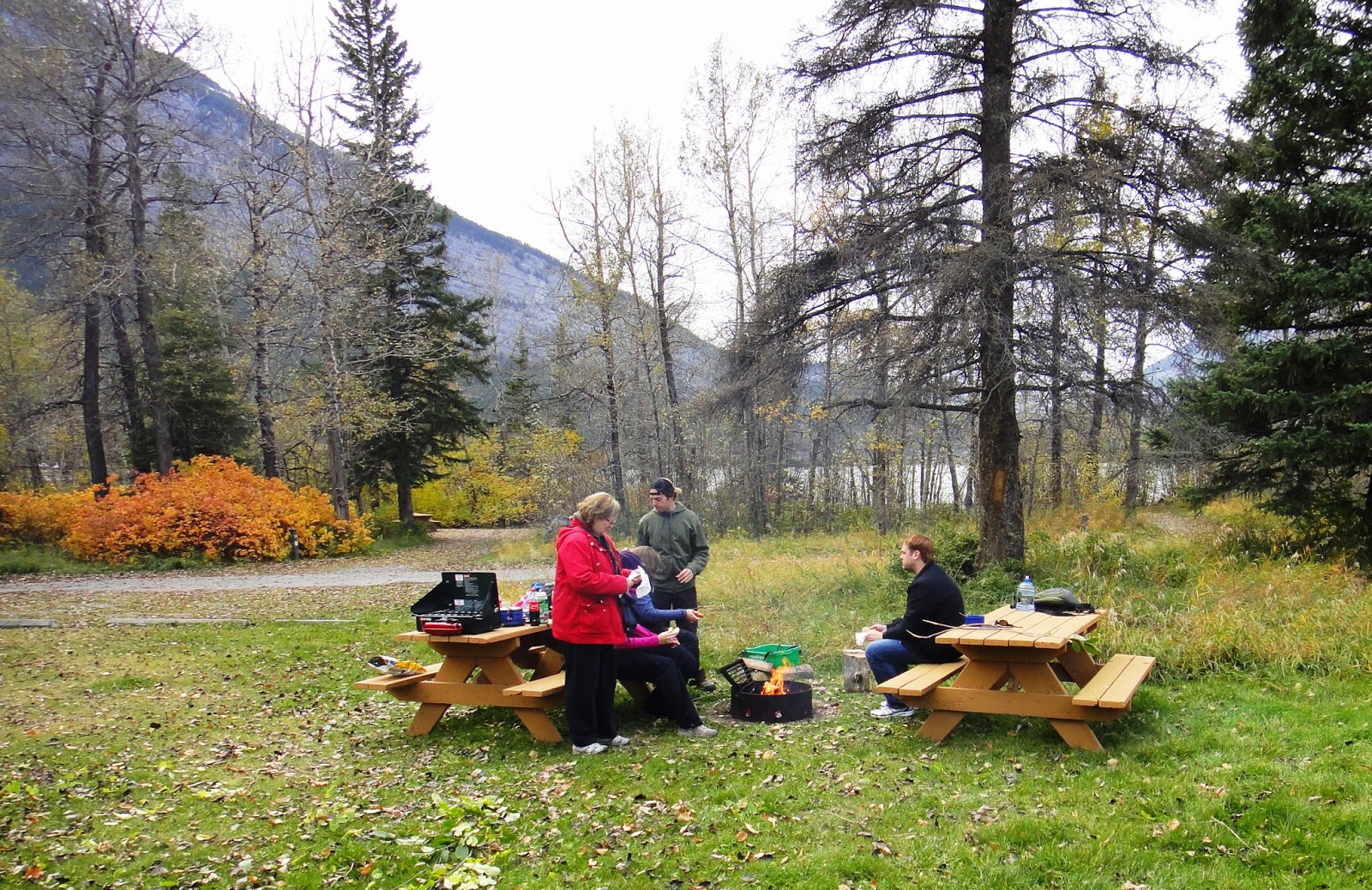
After the hike we headed across the Trans-Canada Highway to the Lac des Arcs day-use area.  Here we had a bonfire, a picnic lunch, and thoroughly enjoyed the weather before driving into Canmore.

Lac des Arcs day-use area
Roasting smokies over the fire and Jerry was able to try out his new Coleman stove!
Canmore's mountain scenery
Policeman's Creek flowing through town
The very next weekend my parents were in town for a visit.  They wanted to spend the day in Banff seeing some of the sites.  We started by driving up to Lake Minnewanka.  The windless day made for some great photos!

Lake Minnewanka
Lake Minnewanka has countless years of history associated with it.  For more than 100 centuries people have hunted and camped along the shores.  The Stoney people called the lake "Minn-waki", which roughly translates to "Lake of the Spirits".  The Stoney respected and feared the lake for its resident spirits.  Early Europeans referred to it as Devil's Lake.

The first building to be built on the shoreline was the "Beach House"; a log hotel erected in 1886.  By 1912 a summer village, called Minnewanka Landing, had been established.  SCUBA divers are the only ones who can visit Minnewanka Landing today as the entire town is under water.  Lake Minnewanka was dammed at least three times.  The first time was in 1895, then again 1912, and finally in 1940.  Collectively the dams raised the water level 25 metres and increased its area by fifty percent, making it the largest lake in Banff National Park.

Mount Inglismaldie standing above the lake
The lake is 28km long and 142m deep
The current dam at the end of the lake with Cascade Mountain looming above
Our next stop was at the ghost town of Bankhead.  Bankhead flourished as a coal-mining town between 1903 and 1922, but all that remains are a few crumbling foundations.  Unfortunately when we arrived at the parking lot we discovered that the whole area was closed for electrofishing.  Since I had no idea what electrofishing was, I had to look it up.  As it turns out, electrofishing is a common scientific survey method where scientists will use electricity to stun fish before they are caught.  When performed correctly electrofishing results in no permanent harm to the fish being studied.  You can read more about the history of Bankhead, as well as view numerous photos, at my previous post titled, Bankhead.

The only site we were able to visit was Bankhead's Holy Trinity Church.  All that remains of the church today are the stone steps.  
After enjoying lunch in Banff we stopped at Bow Falls.  This was our last stop of the day before heading back to Calgary for the evening.  Needless to say we all enjoyed a great day in Banff.

Bow Falls on the Bow River
The view downstream from the falls with Mount Rundle on the right
Bow Falls is 9m tall and 30m wide